World Building (pt 3) – Laws, Ethics, and Morality

In our previous blog post, we discussed the importance of creating a captivating cosmology and mythology for your worldbuilding efforts. Now, let’s focus on another essential aspect: establishing laws, ethics, and morality to create a robust social structure in your story.

Establishing Laws:

Establishing laws in your fictional world is crucial because it provides a framework for governance, order, and social structure. Laws shape societal norms, regulate behavior, and set the stage for conflicts. They can reflect cultural values, political structures, and moral frameworks within the world, creating an intricately woven fabric that adds depth and complexity to your storytelling. By establishing a well-designed legal system, you create a believable and engaging world where characters face challenges and navigate ethical dilemmas, keeping readers invested in their journeys. Establishing laws includes:

  • Creating legal systems and frameworks (e.g., civil law, criminal law),
  • Designing trial processes and punishment methods
  • Incorporating cultural practices and traditions into legal structures

Ethics and Morality: Defining ethics and morality within your fictional world forms the foundation of societal values, beliefs, and norms. Ethics and morality shape how characters behave, make decisions, and interact with each other and their environment. They can influence political structures, economic systems, cultural practices, and even the way conflicts unfold. By establishing a clear moral framework for your world, you create a rich and immersive storytelling experience that resonates with readers on an emotional level, allowing them to connect with characters and the complex dilemmas they face. Specific items to define include:

  • Defining moral frameworks for your world (e.g., utilitarianism, deontology)
  • Establishing societal norms around good vs. evil
  • Creating moral dilemmas and conflicts for characters to navigate

The Interplay with Other World building Elements: A well-designed legal system and moral framework will influence various aspects of your world building in intriguing ways:

• Cosmology and Mythology: Your gods or mythological beings may have a significant impact on laws, ethics, and morality. For example, they could dictate societal norms around justice and compassion.
• Political Structures: The role of lawmakers and enforcers can shape political structures. A strong legal system might provide stability and order, while a weak or corrupt one could create chaos and instability.
• Economics: Laws and ethics can influence economic systems. For instance, rules around property rights and contracts can impact trade relationships and resource distribution.

Practical Applications in Storytelling: By weaving laws, ethics, and morality into your story, you create a rich social fabric that immerses readers in the world and engages their emotions. Here are a few ways to do so:

  • Creating Conflict: Use moral dilemmas and ethical conflicts to challenge your characters and create engaging storylines. For example, a character might face a situation where following the law goes against their personal beliefs or morals.
  • Building Tension: Legal disputes and ethical debates can build tension and suspense in your story, keeping readers invested until the resolution.
  • Creating Characters: Well-defined laws, ethics, and morality can help you create complex characters with unique motivations and moral compasses.

By designing a robust legal system and moral framework and exploring its interplay with other essential worldbuilding elements, you create a more engaging and thought-provoking world that readers will want to explore. Happy writing!


Follow me on AmazonGoodReads, or Facebook to get information about upcoming book releases.

World building: an aside

My past two posts have been about world building for a story. It can be a daunting topic. I wanted to take a pause in looking at the minutia and chat a little about how much is needed to get started.

How much do I need?

Building a world is a daunting task. Figuring out every linkage and relationship is a lot of work for background that may never make it into the page of a story. Think about the volumes Tolkien wrote that were never published during his lifetime. This background material was critical to creating a rich and engaging world for his characters to explore, but was it all necessary?

Only you can make that determination. I like to think that the thought an author puts into their world comes out some way in their writing. I personally like to iterate on ideas and relationships. My latest novel started with a story that ended up being in the middle of the book. It did however set the stage for the world I needed to populate and incorporate into the tale. As the story progressed, I had to write back-story and then answer the critical “so what” questions on why this background mattered to my characters. This gets me to my next point.

When do I need it?

You need it as soon as it fosters a reaction in your characters. Maybe you need something to guide their behavior. Maybe you want something from the past to be a hook into a character’s actions. Perhaps you need a historical or cultural reason for things to exist the way they are in your story. The point is, you won’t know what you need until the story tells you so.

This court of thinking makes it very easy to say “I don’t need a lot of world building upfront.” Depending on your story, that may be the right answer. However, it can also lead you into corners you can’t write your way out of.

In Cosimo, I ran into such a situation. I wanted to have the empire have a technology base while the rest of the planet did not. Why would this situation arise? That led me to writing a back-story of their ancestors fleeing Earth and coming to their new world. Why did they flee? That became part of the back story and in-turn created the rationale for why many of the travelers turned away from technology. I then had to re-work parts of the story to remain consistent with that history.

Five Why’s

Due to this experience, which slowed down my writing the tale I wanted to tell, I suggest you start with some high-level world building. There is a trouble-shooting technique called Five Why’s that can help you explore the cause-and-effect relationships in your story. Simply put, when a story states a belief or cultural reference, ask yourself “why” they believe that? Even just listing these out briefly will give you a good start on a consistent world for your characters to populate.

Let me share a brief example, again from Cosimo. The colonists of the world are split into two broad cultures; the Empire and everyone else:

  1. Why? – because only the empire maintained a technology base on landing.
  2. Why? – because many colonists viewed technology as a source of evil/reason for fleeing Earth.
  3. Why? – Because the unregulated rise of General AI and associated technologies forced them to flee earth.
  4. Why? – Two competing AI forces realized humans were a controllable variable in their instructions to protect the planet; humans would prevent them from achieving their set goals.
  5. Why? – Humans would try and shut them down once they realized the AIs were controlling them to be more docile and regulated.

The final “why’s” of this chain of thinking became foundational to the culture of the story, even if I did not buildout a cosmology and mythology for my world before writing word one.


Follow me on AmazonGoodReads, or Facebook to get information about upcoming book releases.

World building (pt2): Cosmology & Mythology

In this post, we’ll focus on creating a captivating cosmology and mythology as part of your world building efforts. A well-designed cosmology and mythology form the bedrock of your story by establishing the beliefs, values, traditions, and moral frameworks of your characters and their world. Let’s delve into the process of creating a compelling cosmos and mythology that will influence other essential aspects of your world building.

Designing Your Cosmology:

  • Creating the structure of your universe (e.g., flat, spherical, etc.). The structure of your universe will have implications on your mythology as well as the characters who live within it. Think about Terry Pratchett’s DiscWorld series. If you don’t think a cosmology set on a disc riding atop four celestial elephants all standing on the back of Great A’Tuin the space turtle did not influence the stories and characters, you may want to read it again.
  • Establishing its physical properties (e.g., laws of physics). Continuing with the DiscWorld example, not only is the cosmology humorously fantastical, but so are the physics and magical properties of the universe. Reality is spread thinly on the Disc, so events may be affected by expectations, especially those of ‘intelligent’ species such as humans, dwarves, etc. As such, the Discworld is not governed by real-world physics or logic but by belief and narrative resolution. Essentially, if something is believed strongly enough, or by enough people, it may become true.
  • Introducing any celestial bodies, phenomena, or deities. Sticking with the DiscWorld, the very nature of that universe has given rise to 41 stories, many of which reference or explore these aspects of the universe. Small Gods, is a fine example for us all to review.

Constructing a Mythology: Building out your mythology can provide a rich playground for your characters. From deciding how the populations of your world came to be, to what they believe, and how they interact with others based on a shared past, your mythology is fertile ground for interesting ideas and stories to germinate.

  • Creating origin stories for your world and its inhabitants. Having your cosmology is a starting point, but what characters in your world believe about that cosmology could be entirely different. How people came to be in your world can be a great starting point. Using Larry Niven’s Ringworld as an example, we know it was manufactured and populated by a powerful race. But the inhabitants of the place had wholly different myths and beliefs on how they came to be in the world. Knowing something is different than what people believe can be a great mechanism to create conflict and tension between characters and the world.
  • Defining the roles of gods, goddesses, and other supernatural beings. Sticking with our Ringworld example, the builders have taken on aspects of gods to the inhabitants. When they meet the main character (Louis Wu), they believe him to be a god, or a servant of the gods, which colors their interactions with him. Rumors of ‘builders’ who are gods to the inhabitants helps drive Louis’s journey across the world as well.
  • Designing myths, legends, and folktales that shape societal beliefs. Something happened to the Ringworld that unsettled the natural balance there. Without going into spoilers, these events in the distant past shaped the beliefs of the people, and gave rise to the legends they share during the story. Eventually, the myths give way to facts that our heroes need to escape the world they’ve landed on.

Interplay with Other World building Elements:
A well-crafted cosmology and mythology will influence various aspects of your world building in interesting ways:

  • Laws, Ethics, and Morality: A culture’s moral framework can be shaped by its gods, myths, and legends. For example, the tenets of a particular religion could dictate societal norms around justice and compassion.
  • Political Structures and Economies: Mythology can influence political structures through the creation of divine kings or god-appointed leaders. It can also impact economies by shaping trade relationships and resource distribution.
  • Building Landscapes and Geography: Cosmology and mythology can inform the geography of your world. For instance, a particular deity may be associated with mountains, while another could be connected to rivers or forests.

Practical Applications in Storytelling:
By weaving cosmology and mythology into your story, you create layers of depth that immerse readers in the world and engage their emotions. Here are a few ways to do so:

  • Establishing Connections: Make connections between characters and the gods or mythological beings they encounter. This can provide insight into their motivations and help build emotional resonance.
  • Creating Conflict: Use mythology to create internal conflicts within your characters. For example, a character might struggle with conflicting moral values based on different deities or beliefs.
  • Building a Sense of History: A rich cosmology and mythology can provide a sense of history for your world, making it more believable and immersive for readers.

By designing an intriguing cosmology and mythology and exploring its interplay with other essential worldbuilding elements, you create a more engaging and memorable world that readers will want to explore.


Follow me on AmazonGoodReads, or Facebook to get information about upcoming book releases.

World building: Crafting Rich, Imaginative Settings for Your Stories (pt 1)

We’ve talked about character creation using my character template, but what good are characters that don’t interact in a rich and inviting world? This is the first in a series of posts about building compelling worlds and societies for our characters to interact in.

Crafting Captivating Worlds

Creating truly captivating worlds for stories is a multifaceted endeavor, influenced by both the readers’ preferences and the author’s intended message. Will the environment be so unforgiving that survival becomes a daily struggle for the characters, or so ordinary that it blends into the background of the “real world”? Even within the “real world,” experiences vary across different regions; a simple drive down the road can be vastly different depending on the country. It’s these real-world disparities that have the potential to profoundly impact your story and characters. As an author, it’s crucial to be aware of these differences to build and maintain the trust of your readers.

The Role of World-Building in Fiction

When embarking on your world-building journey, it is paramount to ponder, What matters in your world? This pivotal question sets the stage for the creation of a compelling setting. In J.R.R. Tolkien’s Middle Earth, the battleground between lightness and darkness serves as a cornerstone for the world and its cultures, allowing characters to traverse the glories of the past while confronting present conflicts. Similarly, in Larry Niven’s Ringworld, the main world transcends being a mere backdrop; it is elevated to the status of a character within the larger Known Space Universe. The Ringworld, therefore, functions as both an environment to be explored and a puzzle to be unraveled by the characters. A common thread between these worlds is the pivotal role played by the world itself in driving character conflicts and interactions, thus serving as a linchpin in the overall plot.

Our Roadmap

We’re going to kick-off this series of posts looking at five elements of world building that I feel apply regardless of the genre you’re writing in. These are:

  • Creating believable cultures and histories,
  • Establishing laws, ethics, and morality,
  • Developing political structures and economies,
  • Building landscapes and geography, and
  • Constructing a cosmology and mythology

All of these elements are inter-twined. A mythology will affect culture and history, the laws and ethics of the people of the world and possibly the political structures. The landscape and geography should influence the economies and cultures, which will have an effect on the history of the people. By thoughtfully considering how these elements intersect, writers create rich, interconnected worlds that offer endless opportunities for exploration and discovery.

Once these five elements have been explored, we’ll add in things that you may want to consider for genre specific worlds, like Crafting Magical Systems and Fantastical Elements, and Incorporating Technology and Infrastructure.

For subscribers, I’ll also share a handy aid for your own world building journey.


If you haven’t already subscribed to get access to the free character template, and my world-building guide, please do. There will be more subscription only content soon, including my novel outline tool that includes the character template.


Follow me on AmazonGoodReads, or Facebook to get information about upcoming book releases.

Creating Compelling Characters (pt 6)

This six-part series will walk through the sections of my Character Template, describe how to use that template, and why you should go to this effort. I’ll sprinkle in some behind-the-scenes usage of the template as I’ve applied it to my latest writing efforts. My template is available for free to all subscribed members, so subscribe today and follow-along.


The Rest of the Story

Welcome to our final installment in this series on creating compelling characters using the character template. I’ve spent most of this series on what some might call the obvious aspects of creating a character. The template actually has many more sections. While I believe they are mostly self explanatory, I wanted to cover a few items that haven’t been touched on yet.

Context

Each character serves a purpose in the overall story. The first section of the template captures this context for the character. What’s their name? What gender are they? Are they from a recognizable race or culture? What’s their role in the story? Are they the hero or the villain? A side-kick? Comic relief? Defining what role they are expected to play can help with all of the other details in the template.


The physical, part 2

I chose not to cover every section of the physical descriptions. I did not touch on any physical abilities they may have, or specific physical vulnerabilities. Characters may have active abilities they can use, or passive abilities that just are. They also have limits to those abilities. Every Superman needs a little kryptonite to keep them on their toes.

These physical capabilities may be relevant as part of the character’s physical description or may drive their strengths and unique abilities. Alternatively, they could be linked to the weaknesses and vulnerabilities for your character. As you use the template, you’ll have to decide if these aspects are important and what other parts of the template they relate to.


Social Connections

Relationships and romance could be an important part of the character’s growth arc. Detailing these out early in your planning could drive dialog, actions, and emotional outcomes throughout the story.

These social connections may be what drives the character’s motivations and goals, or maybe fuels their emotional growth arc.


Conflict

Every great story features struggles that push characters out of their comfort zones and force them to grow. Let’s examine how a character grapples with internal and external conflicts within the template.

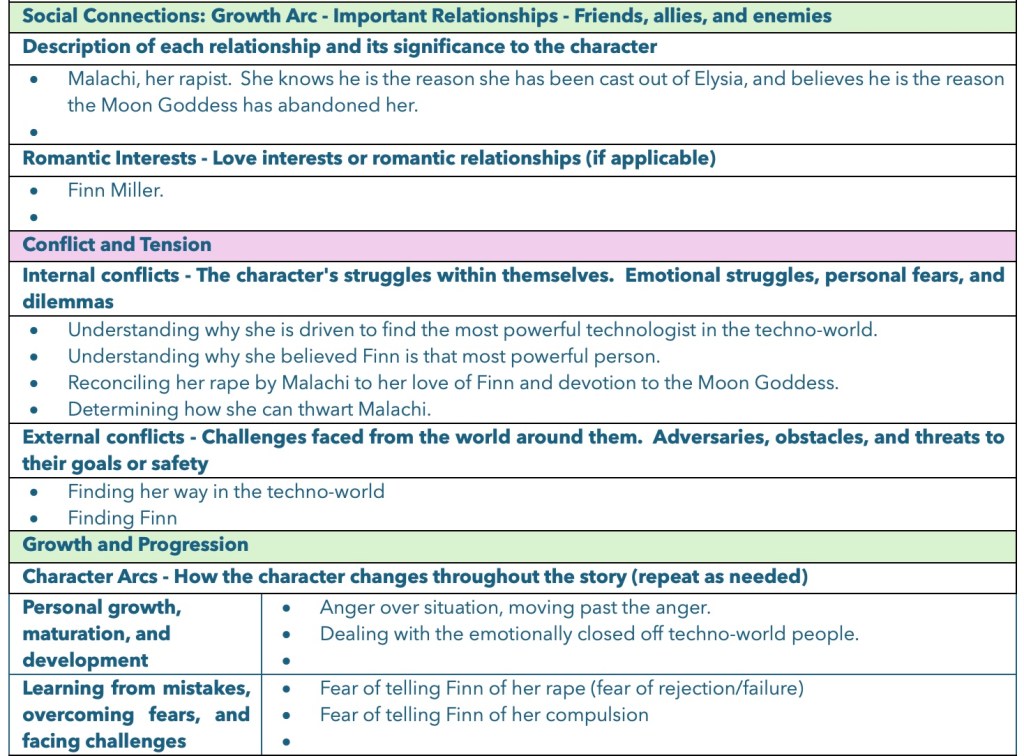
First up, let’s look at internal conflict. [Character Name] is a complex individual plagued by her past, particularly an incident in which she was falsely accused of betraying her friends. This internal struggle manifests as crippling self-doubt and fear of being trusted again. Her inner turmoil leads to emotional conflicts with those around her and prevents her from fully embracing new relationships or opportunities.

Internal conflicts give your characters depth and complexity, making them more relatable and compelling for readers. They also offer opportunities for character growth as the characters confront their fears, face their personal demons, and learn to overcome their emotional struggles.

In the broader world, the external conflicts our character’s face is likely a significant element of the overall story. [Character Name’s] external conflicts come in the form of a powerful enemy seeking vengeance for the past betrayal that she didn’t commit. This adversary poses a grave threat not only to her personal safety but also to those closest to her. As [Character Name] navigates this dangerous situation, she must confront her inner fears and learn to rely on new allies if she wants to protect herself and those she cares about.

External conflicts provide the tension and suspense that keep your readers engaged in the story. They also offer opportunities for character development as the characters face challenges that test their limits, forcing them to grow and adapt.

This leads to planning the character arc.

Internal conflicts and character arcs create a powerful narrative that resonates with readers on an emotional level. They offer opportunities for characters to grow and evolve, providing satisfying closure and leaving the audience with a sense of fulfillment.

External conflicts offer opportunities for characters to prove themselves in challenging situations, highlighting their strengths and showing how they’ve evolved throughout their journey. They create an exciting narrative that keeps readers invested until the very end.

Here are these sections for my character Elara. She is still a work in progress, but is shaping up nicely. If you read through this, I hope you can get a sense of her story and how her interactions with the other characters would change her in a satisfying manner. I hope to publish Elara’s tale before the end of the year.


By skillfully balancing internal conflicts, external conflicts, and character arcs using the character template, you create a captivating, cohesive story that resonates with readers and leaves them eager for more adventures featuring your compelling characters!


This concludes the series on how I use my character template. I hope you’ve enjoyed it. Next month, I’ll be posting my Novel Outline tool that helps me map the journey my characters will travel. Stay tuned for more!


If you haven’t already subscribed to get access to the free character template, please do. There will be more subscription only content soon, including my novel outline tool that includes the character template.


Follow me on AmazonGoodReads, or Facebook to get information about upcoming book releases.

Creating Compelling Characters (pt 5)

This six-part series will walk through the sections of my Character Template, describe how to use that template, and why you should go to this effort. I’ll sprinkle in some behind-the-scenes usage of the template as I’ve applied it to my latest writing efforts. My template is available for free to all subscribed members, so subscribe today and follow-along.


Those messy emotions

Welcome to our fifth installment in this series on creating compelling characters using the character template. Today, we’ll delve into the importance of emotional growth and progression in crafting complex, engaging stories that resonate with readers.


The template section

A character’s background shapes who they are and influences their motivations, actions, and decisions. For [Character Name], her upbringing in a secluded monastery after her village was destroyed instilled a strong sense of discipline and inner peace within her. This kind of background context not only adds depth to the story but also makes the character more relatable and authentic.

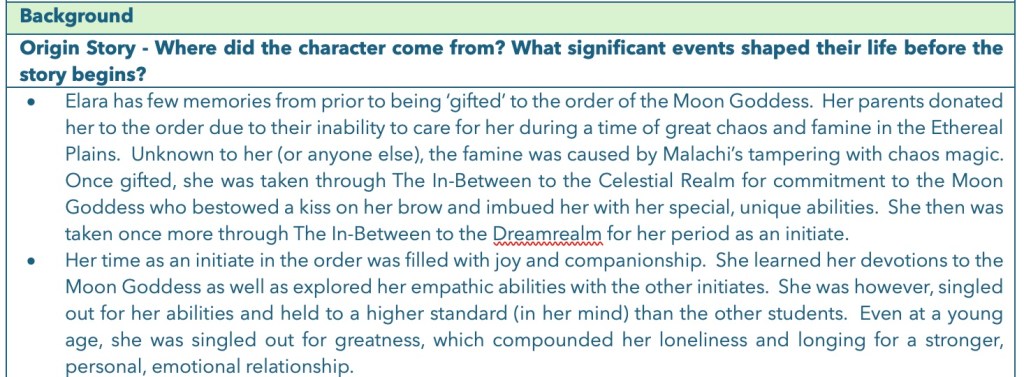
The background information you choose to put into the template may be sparse or very detailed. Elara’s background spans nearly half a page (too much to post here), but this is an excerpt of it:

A richly developed background provides valuable information about a character’s origins, family history, education, and notable relationships, allowing readers to better understand their motivations and emotional journeys. This background, with a simple mapping of the character’s history and relationships will inform and drive their emotional challenges and growth as well.


Template section

Emotional Challenges
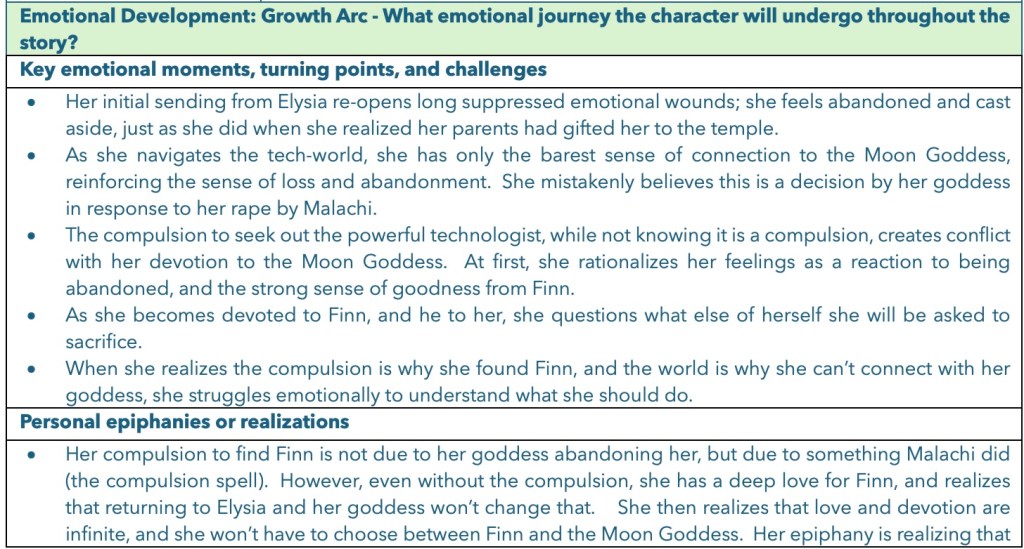
Every character faces emotional challenges throughout their journey – be it grief, loss, betrayal, or fear. In our example, Character Name experiences profound grief and anger after losing her loved ones. This emotional turmoil not only adds depth to the story but also creates opportunities for character development.

Personal Epiphanies and Realizations
Emotional growth often involves gaining new insights about ourselves or the world around us. For Character Name, her emotional journey leads her to discover the true meaning of family, community, and forgiveness. Through these experiences, she learns valuable lessons and grows as a person.

Let’s look at my sample character once more. As you can see, big parts of her character arc have been fleshed out here. As you can imagine, this has given me the structure to make some interesting interpersonal conflicts in the plot as well as present key challenges to move the story forward.

So-What?
By focusing on emotional growth and progression in our characters, we create stories that resonate with readers and leave lasting impressions. These elements not only make our characters more relatable but also add depth and complexity to the narrative, ensuring a satisfying and rewarding reading experience for our audience.


Remember, every great story is fueled by compelling characters who evolve and grow throughout their journey. In our next installment of this series, we’ll explore how relationships play a crucial role in shaping our characters and adding depth to their stories. Stay tuned!


Follow me on AmazonGoodReads, or Facebook to get information about upcoming book releases.

Creating Compelling Characters (pt 4)

This six-part series will walk through the sections of my Character Template, describe how to use that template, and why you should go to this effort. I’ll sprinkle in some behind-the-scenes usage of the template as I’ve applied it to my latest writing efforts. My template is available for free to all subscribed members, so subscribe today and follow-along.


Motivations and Goals

Welcome to our fourth installment of exploring compelling character creation through the lens of the character template. In this blog post, we’ll delve into the power of motivations and personal goals that guide your characters forward and infuse a sense of purpose throughout their stories.


The template section

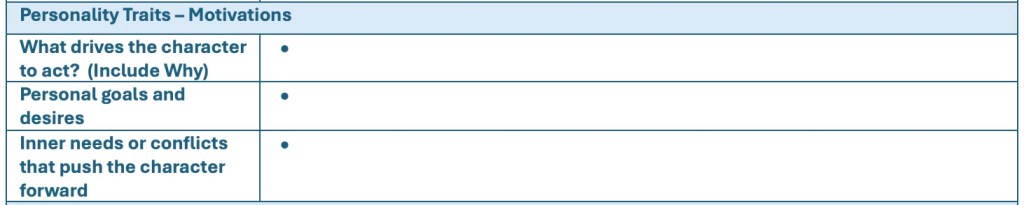
Motivations
First, let’s explore what drives a character to act, as these motivations shape their actions and decisions. For instance, [Character Name] seeks revenge against the pirate captain who destroyed her home village and killed her family out of a deep-rooted desire for justice and closure. Understanding a character’s motivation not only adds depth but also creates opportunities for engaging conflict resolution and character development.

Personal goals and desires
Moreover, every compelling character should have an ultimate goal or desire driving them forward. Consider [Character Name’s] dream of building a peaceful community where her people can live harmoniously with nature. This personal objective not only provides direction but also creates opportunities for growth and conflict as she faces the challenges that come her way.

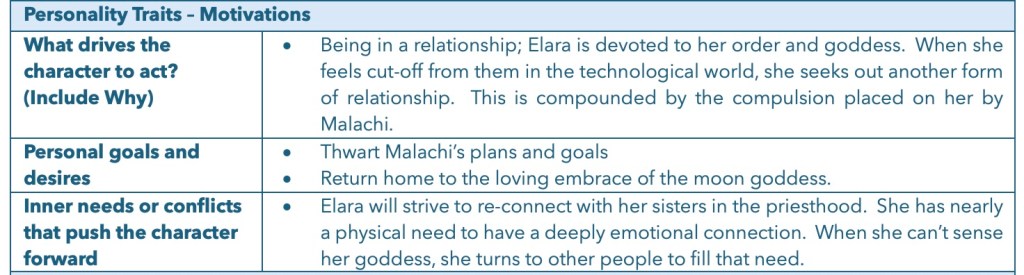
Let’s look at it in practice. Remember, I built out the character sheet for Elara, before starting to write the story.

You can already see what is going to drive Elara’s action as she faces obstacles in her journey. Malachi (the antagonist of the tale) is the reason she has been cut off from her sisterhood. Since I’m early in the writing of her story, I can’t share how these traits, motivations, and goals have translated to the page, but I know they will

By understanding how motivations and personal goals contribute to compelling characters, we can effectively write engaging stories that resonate with readers by providing a clear sense of purpose and direction for our characters. Stay tuned as we continue our exploration of character development using the character template!


Up next: In the fifth blog post, we’ll discuss using the character template for emotional growth and progression throughout the story, which adds depth and complexity to your characters and creates opportunities for powerful, satisfying narratives. Don’t miss it!


Follow me on AmazonGoodReads, or Facebook to get information about upcoming book releases.

Creating Compelling Characters (pt 3)

This six-part series will walk through the sections of my Character Template, describe how to use that template, and why you should go to this effort. I’ll sprinkle in some behind-the-scenes usage of the template as I’ve applied it to my latest writing efforts. My template is available for free to all subscribed members, so subscribe today and follow-along.


Don’t be so Negative, but be vulnerable

In this, our third installment of character creation using the template, we’ll delve into the realm of personality traits – weaknesses and vulnerabilities. These elements are essential for adding depth to your character and creating opportunities for growth and development throughout the story.


The template section

Weaknesses
Begin by exploring negative traits and flaws that challenge a character. For instance, [Character Name’s] arrogance can land her in hot water when she underestimates opponents or neglects important details. By acknowledging these weaknesses, we create opportunities for character growth as the characters learn to confront and overcome their personal challenges.

Vulnerabilities and fears:
Moreover, each character should have a fear or insecurity that can be exploited by adversaries. Consider [Character Name’s] greatest fear of drowning; this vulnerability puts her in peril during underwater battles and adds tension to these scenes. Fears and vulnerabilities not only make the characters more relatable but also provide engaging conflict opportunities, keeping readers invested in their journey.

Let’s continue looking at my sample character, Elara:

These few short lines made Elara a much more interesting character for my story. They speak to the fears that drive her and potential pitfalls she may have to overcome as the story develops. Once again, these motivations came about before I wrote the first sentence of the story. In the third chapter, while still setting up the over all plot lines, I tapped into these vulnerabilities to engage the reader in Elara’s plight:

Her goddess had truly forsaken her if she could not fight this compulsion on her mind.  While she wanted to resist the pity welling up in her throat, her loss was all consuming.  For the first time since being raised as an acolyte, she cried with the nearly silent sobs from her childhood.  

Alone and abandoned again.

By understanding how personality traits, particularly weaknesses and vulnerabilities, contribute to compelling characters, we can effectively create complex, human stories that resonate with readers. Stay tuned as we continue our exploration of character development using the character template!


Up next: In the fourth blog post, we’ll discuss using the character template for personal motivations, goals, and inner conflicts, which drive the characters forward and shape their arcs throughout the story. Don’t miss it!


Follow me on AmazonGoodReads, or Facebook to get information about upcoming book releases.

Creating Compelling Characters (pt 2)

This six-part series will walk through the sections of my Character Template, describe how to use that template, and why you should go to this effort. I’ll sprinkle in some behind-the-scenes usage of the template as I’ve applied it to my latest writing efforts. My template is available for free to all subscribed members, so subscribe today and follow-along.


Personality Matters

In our second exploration of character creation using the template, we’ll dive into the depths of personality traits – strengths and unique abilities. These elements are crucial for making your character stand out and contributing to their overall appeal and intrigue.


The template section

Strengths
First, let’s delve into positive traits and characteristics that make a character endearing. For instance, [Character Name] embodies kindness, always putting others before herself, showcasing her selfless nature. Moreover, she displays unwavering determination when tackling challenges, revealing her tenacious spirit. These strengths not only make our character relatable but also provide opportunities for reader engagement and investment.

Inherent abilities that make the character unique:
Moreover, each character should possess a distinctive talent or skill that sets them apart from others. Consider [Character Name’s]rare ability to communicate with animals. This unique trait not only adds depth to her character but also offers exciting possibilities for forming deep connections with various creatures throughout her adventures. These unique abilities provide engaging conflict resolutions and opportunities for character development, making your story even more captivating.

Once again, a single line in the template can be expanded greatly. I wanted Elara to have incredibly strong empathy for some of the other characters in the story. While I haven’t tapped into these abilities in the narrative yet, they are on her character sheet and I’ve got plenty of notes on where they will matter.

By focusing on a clear understanding of how personality traits contribute to compelling characters, we can effectively harness their strengths and unique abilities to create unforgettable stories that resonate with readers. Stay tuned as we continue our exploration of character development using the character template!


Up next: In the third blog post, we’ll discuss using the character template for personality traits – weaknesses and vulnerabilities, which add depth and relatability to your characters. Don’t miss it!


Follow me on AmazonGoodReads, or Facebook to get information about upcoming book releases.