Creating Compelling Characters (pt 4)

This six-part series will walk through the sections of my Character Template, describe how to use that template, and why you should go to this effort. I’ll sprinkle in some behind-the-scenes usage of the template as I’ve applied it to my latest writing efforts. My template is available for free to all subscribed members, so subscribe today and follow-along.


Motivations and Goals

Welcome to our fourth installment of exploring compelling character creation through the lens of the character template. In this blog post, we’ll delve into the power of motivations and personal goals that guide your characters forward and infuse a sense of purpose throughout their stories.


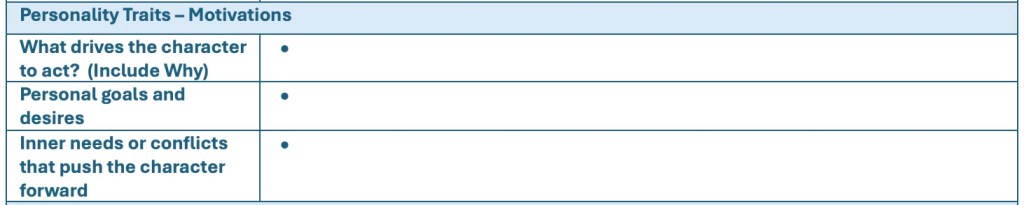
The template section

Motivations
First, let’s explore what drives a character to act, as these motivations shape their actions and decisions. For instance, [Character Name] seeks revenge against the pirate captain who destroyed her home village and killed her family out of a deep-rooted desire for justice and closure. Understanding a character’s motivation not only adds depth but also creates opportunities for engaging conflict resolution and character development.

Personal goals and desires
Moreover, every compelling character should have an ultimate goal or desire driving them forward. Consider [Character Name’s] dream of building a peaceful community where her people can live harmoniously with nature. This personal objective not only provides direction but also creates opportunities for growth and conflict as she faces the challenges that come her way.

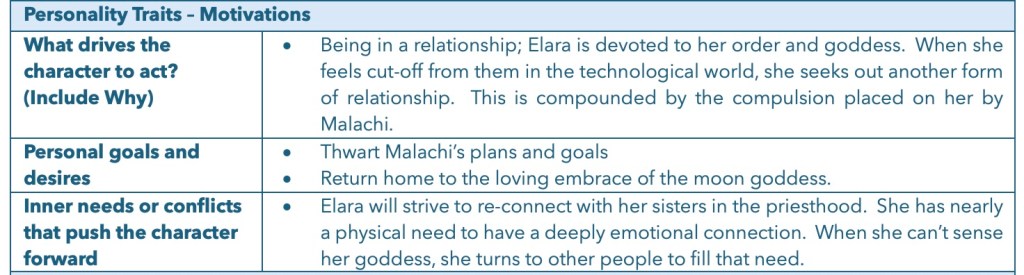
Let’s look at it in practice. Remember, I built out the character sheet for Elara, before starting to write the story.

You can already see what is going to drive Elara’s action as she faces obstacles in her journey. Malachi (the antagonist of the tale) is the reason she has been cut off from her sisterhood. Since I’m early in the writing of her story, I can’t share how these traits, motivations, and goals have translated to the page, but I know they will

By understanding how motivations and personal goals contribute to compelling characters, we can effectively write engaging stories that resonate with readers by providing a clear sense of purpose and direction for our characters. Stay tuned as we continue our exploration of character development using the character template!


Up next: In the fifth blog post, we’ll discuss using the character template for emotional growth and progression throughout the story, which adds depth and complexity to your characters and creates opportunities for powerful, satisfying narratives. Don’t miss it!


Follow me on Amazon, GoodReads, or Facebook to get information about upcoming book releases.

Creating Compelling Characters (pt 3)

This six-part series will walk through the sections of my Character Template, describe how to use that template, and why you should go to this effort. I’ll sprinkle in some behind-the-scenes usage of the template as I’ve applied it to my latest writing efforts. My template is available for free to all subscribed members, so subscribe today and follow-along.


Don’t be so Negative, but be vulnerable

In this, our third installment of character creation using the template, we’ll delve into the realm of personality traits – weaknesses and vulnerabilities. These elements are essential for adding depth to your character and creating opportunities for growth and development throughout the story.


The template section

Weaknesses
Begin by exploring negative traits and flaws that challenge a character. For instance, [Character Name’s] arrogance can land her in hot water when she underestimates opponents or neglects important details. By acknowledging these weaknesses, we create opportunities for character growth as the characters learn to confront and overcome their personal challenges.

Vulnerabilities and fears:
Moreover, each character should have a fear or insecurity that can be exploited by adversaries. Consider [Character Name’s] greatest fear of drowning; this vulnerability puts her in peril during underwater battles and adds tension to these scenes. Fears and vulnerabilities not only make the characters more relatable but also provide engaging conflict opportunities, keeping readers invested in their journey.

Let’s continue looking at my sample character, Elara:

These few short lines made Elara a much more interesting character for my story. They speak to the fears that drive her and potential pitfalls she may have to overcome as the story develops. Once again, these motivations came about before I wrote the first sentence of the story. In the third chapter, while still setting up the over all plot lines, I tapped into these vulnerabilities to engage the reader in Elara’s plight:

Her goddess had truly forsaken her if she could not fight this compulsion on her mind.  While she wanted to resist the pity welling up in her throat, her loss was all consuming.  For the first time since being raised as an acolyte, she cried with the nearly silent sobs from her childhood.  

Alone and abandoned again.

By understanding how personality traits, particularly weaknesses and vulnerabilities, contribute to compelling characters, we can effectively create complex, human stories that resonate with readers. Stay tuned as we continue our exploration of character development using the character template!


Up next: In the fourth blog post, we’ll discuss using the character template for personal motivations, goals, and inner conflicts, which drive the characters forward and shape their arcs throughout the story. Don’t miss it!


Follow me on Amazon, GoodReads, or Facebook to get information about upcoming book releases.

Creating Compelling Characters (pt 2)

This six-part series will walk through the sections of my Character Template, describe how to use that template, and why you should go to this effort. I’ll sprinkle in some behind-the-scenes usage of the template as I’ve applied it to my latest writing efforts. My template is available for free to all subscribed members, so subscribe today and follow-along.


Personality Matters

In our second exploration of character creation using the template, we’ll dive into the depths of personality traits – strengths and unique abilities. These elements are crucial for making your character stand out and contributing to their overall appeal and intrigue.


The template section

Strengths
First, let’s delve into positive traits and characteristics that make a character endearing. For instance, [Character Name] embodies kindness, always putting others before herself, showcasing her selfless nature. Moreover, she displays unwavering determination when tackling challenges, revealing her tenacious spirit. These strengths not only make our character relatable but also provide opportunities for reader engagement and investment.

Inherent abilities that make the character unique:
Moreover, each character should possess a distinctive talent or skill that sets them apart from others. Consider [Character Name’s]rare ability to communicate with animals. This unique trait not only adds depth to her character but also offers exciting possibilities for forming deep connections with various creatures throughout her adventures. These unique abilities provide engaging conflict resolutions and opportunities for character development, making your story even more captivating.

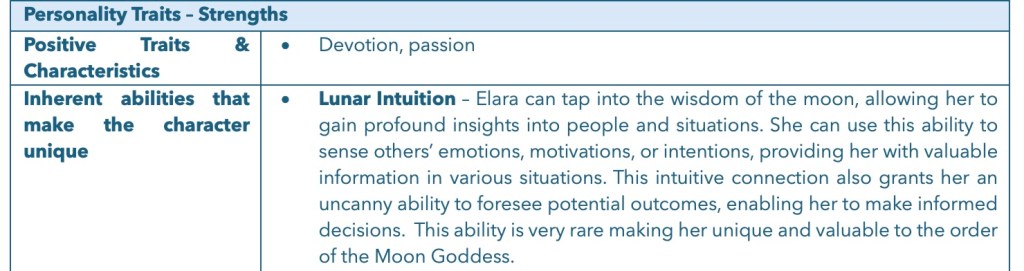
Once again, a single line in the template can be expanded greatly. I wanted Elara to have incredibly strong empathy for some of the other characters in the story. While I haven’t tapped into these abilities in the narrative yet, they are on her character sheet and I’ve got plenty of notes on where they will matter.

By focusing on a clear understanding of how personality traits contribute to compelling characters, we can effectively harness their strengths and unique abilities to create unforgettable stories that resonate with readers. Stay tuned as we continue our exploration of character development using the character template!


Up next: In the third blog post, we’ll discuss using the character template for personality traits – weaknesses and vulnerabilities, which add depth and relatability to your characters. Don’t miss it!


Follow me on Amazon, GoodReads, or Facebook to get information about upcoming book releases.

Creating Compelling Characters (pt 1)

This six-part series will walk through the sections of my Character Template, describe how to use that template, and why you should go to this effort. I’ll sprinkle in some behind-the-scenes usage of the template as I’ve applied it to my latest writing efforts. My template is available for free to all subscribed members, so subscribe today and follow-along.


Focus on the physical

Bringing a new character to life on the page can be an exciting and daunting task. One of the first elements to consider when crafting a character is their physical description. This crucial aspect sets the foundation for your character’s visual identity and helps readers connect with them on a sensory level. In this blog post, we’ll dive into using the character template for physical descriptions and explore why it matters in creating compelling characters.

The Power of Physical Descriptions
Physical descriptions serve as the initial impression readers have of your character. They create mental images that help readers differentiate between various characters in the story and immerse themselves in the world you’ve built. These details also offer opportunities for symbolism, adding depth and meaning to your characters through visual cues. For instance, a character with a prominent scar might symbolize their past struggles or resilience.

The top of the template

Building a Character from the Ground Up
Let’s explore an example using our character template. [Character Name] is a tall, lean man with short, curly brown hair and piercing blue eyes. A scar above his eyebrow adds an air of mystery. This physical description paints a vivid image in the reader’s mind, helping them connect with the character on a deeper level. It also creates intrigue, leaving readers wondering about the origins of the scar and what it might signify about [Character Name’s] past.

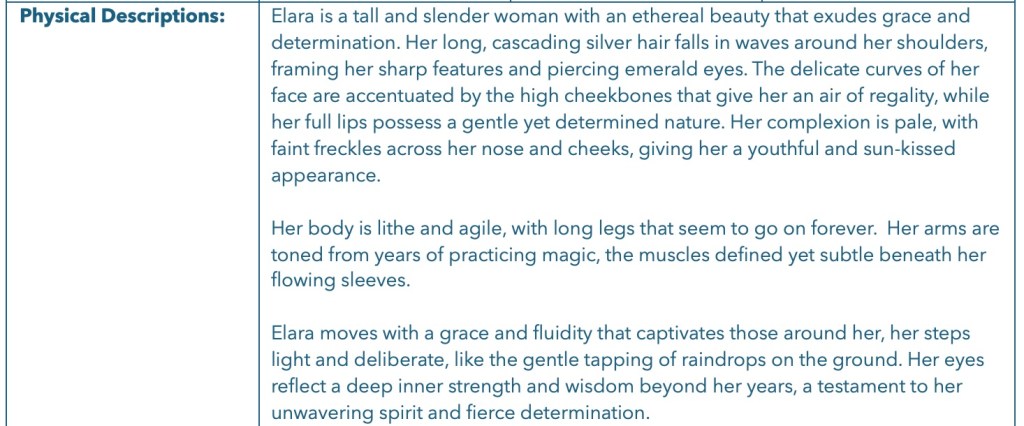
Notice the template has a single line for what could be a lot of descriptive text. Put whatever works for you in there. Here’s an example of a character I’ve been working on recently.

Crafting Authentic Physical Descriptions
When crafting physical descriptions, it’s essential to strike a balance between detail and authenticity. Be specific yet avoid descending into excessive or unrealistic details that may detract from the story rather than adding to it. Instead, focus on the elements of your character’s appearance that are relevant to their personality, backstory, or role in the narrative.

Incorporating Physical Descriptions into Your Writing
Physical descriptions can be seamlessly integrated into your writing in various ways. For example, you might describe a character’s appearance during an introduction or reveal their physical traits through the actions and interactions they have with other characters. Remember, physical descriptions should serve to enhance the story rather than detract from it, providing readers with valuable insights into your characters while keeping them engaged and invested in the narrative.

Continuing to use the sample for Elara, here’s how it shows up in my first draft:

She looked up at him as he stopped his flight.  Her long, cascading silver hair fell in waves around her shoulders, framing her sharp features and piercing emerald eyes. The delicate curves of her face are accentuated by the high cheekbones giving her an air of regality, while her lips were full of promise, but set in determination as she stifled her crying. Her complexion was pale, but faint freckles were just visible in the poor light, giving her a youthful and sun-kissed appearance.

Notice this is almost a cut-and-paste of the description I built in the template. I won’t continue re-using the same parts of the description, but this made it simple for me to get the first impression out of my head, onto the page, and then shift back into the action of this part of the story.

Appearance and Style
In addition to the physical appearance, details about their style and mannerisms are essential for bringing them to life for the reader. Details such as clothing and personal items can reflect their personality and provide readers with a clear image of their unique style. For instance, [Character Name’s] leather jacket and wooden staff adorned with symbols from her home village offer insights into her tough exterior and strong connection to her roots.

A well-defined appearance not only adds visual appeal but also offers opportunities for symbolism and character development through subtle visual cues. These details help readers connect with the characters on a deeper level and create an immersive reading experience.

Part of a character’s style may be mannerisms, patterns of speech, or ‘ticks’ they have. Unique ways of speaking that reveal a character’s personality or background. For example, [Character Name] has a habit of pausing dramatically before delivering important information, emphasizing her wisdom and thoughtfulness.

Similarly, gestures and body-language can reveal a character’s thoughts, emotions, and intentions, providing readers with a clearer understanding of their motivations and reactions. Maybe [Character Name] often fiddles with her necklace when she’s nervous or uneasy, adding tension to sensitive scenes and highlighting her emotional vulnerability. These sorts of details add nuance and depth to the storytelling, allowing readers to connect more deeply with the characters and their experiences.

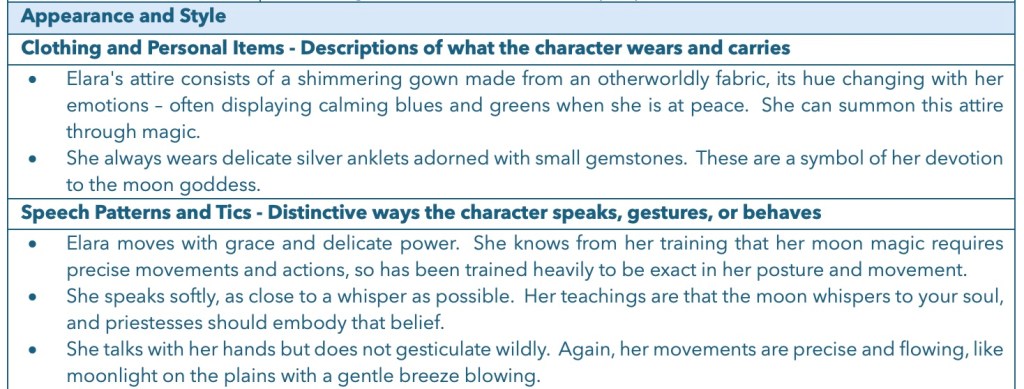
Looking at this part of the template for Elara gives some additional insight into how I might incorporate these details into her story:

A Visual Feast for Readers
Using the character template for physical descriptions is an essential aspect for me crafting compelling characters. These details provide readers with a tangible image of your characters, helping them connect on a sensory level and immerse themselves in the story. By focusing on authentic, relevant physical descriptions that add depth and meaning to your characters, you’ll create an engaging and memorable reading experience for your audience.


Stay tuned for our next blog post in this series, where we’ll delve into using the character template for personality traits and explore how they contribute to creating compelling characters.


Follow me on Amazon, GoodReads, or Facebook to get information about upcoming book releases.

What’s in a name?

Hey there, fellow storytellers!

In today’s post, we’re diving into a topic that might seem small but can have a big impact on your characters – character names. I mean, think about it; the right name can add depth and intrigue to your characters in ways you never thought possible! So, let’s chat about some aspects to consider when picking character names for your stories.


This post isn’t really about my character template and how to use it, but is definitely complimentary to the series of posts about the template. If you haven’t seen it yet, check it out!


Names That Reflect Character Traits:
A character’s name can be a subtle hint about their personality or background. For instance, a “Thorn” might sound prickly and difficult, while “Daisy” suggests innocence and purity. Consider how the meaning or sound of a name aligns with your character’s traits and backstory.

Cultural and Historical Significance:
Adding names from various cultures and historical periods can make your characters more interesting and diverse. For example, an African name might suit a character from that region, or a Medieval name could be fitting for a story set in that time period. Researching the meaning and significance behind different names can lead to some unique and fascinating character choices!

If you are looking for a good resource to help you here, check out Behind the Name. There are other resources online as well for finding common and un-common names from specific cultures.

While working on my most recent tale, one of the main characters is a priestess to the Moon Goddess, so I decided to use Elara Moonblossom as her name. In Greek mythology, Elara was one of Zeus’ mortal lovers, which coincides with my character’s beauty and devotion to her god. Moonblossom reinforces the relationship to the goddess of the moon, and the fact that the character has an ethereal beauty.

Unique Spelling and Pronunciation:
Give your characters a distinct edge with a one-of-a-kind name! Unusual spellings or pronunciations can add intrigue, making readers take notice. But be careful not to make the name too difficult for readers to remember or say – you wouldn’t want them to get frustrated and put down your story because they can’t wrap their heads around a character’s name!

In my stories about the Families of the Empire, I chose Cosimo as the protagonist’s name. It is a unique name, but also has some history; Cosimo de’ Medici, the 15th-century founder of Medici rule in Florence, was a patron of the Renaissance and a successful merchant. It plays well for the role my character takes on.

Character Evolution:
As characters grow and change throughout a story, their names can sometimes evolve with them. For example, a character might adopt a new name after a significant life event, or a nickname might stick that better represents their transformed personality. Keep in mind the potential for character development when choosing a name.

I’ve used this technique myself, having a character named, lost her name due to becoming convicted of a crime, and then being give another pseudonym while on a covert mission.

Balancing Realism and Fantasy:
For realistic stories, consider names that fit the cultural and historical context of your setting. However, fantasy stories offer more freedom to explore unusual or made-up names. Be mindful of striking a balance between realism and fantasy, ensuring that the names feel appropriate for your story’s genre and tone.


What do you think? Have you used any unique or interesting character names in your own writing? I’d love to hear about it! Share your thoughts in the comments below, and let’s continue this conversation. Happy writing!


Follow me on Amazon, GoodReads, or Facebook to get information about upcoming book releases.

Crafting Compelling Characters with a Character Template

Welcome to my series on crafting compelling characters using a character template. This essential tool helps structure well-rounded, engaging characters for your stories by covering aspects such as physical descriptions, personality traits, motivations, and more. Join me as I share my experiences and lessons learned while using this versatile guide to bring dynamic, multifaceted characters to life.


Now, before I dive into the nitty-gritty of character creation, let me give you a little background on this versatile tool. The character template I’ve created is a quick guide designed to help us structure well-rounded and engaging characters for our stories. It covers various aspects, from physical descriptions and personality traits to motivations, personal goals, and emotional growth.

But why use a template, you ask? Well, crafting compelling characters can sometimes feel like a daunting task – like trying to capture lightning in a bottle. This template provides me with a solid foundation and valuable insights as I embark on the writing journey. Additionally, it offers practical prompts and exercises that make the character creation process more manageable and enjoyable.

For registered readers of my blog, you’ll have access to the template to use in your own writing. I believe that everyone has a unique storytelling voice, and I can’t wait to see how this template inspires and informs yours. So, grab a pen and paper (or your preferred writing tool), and let’s begin our exploration of character development together!


Follow me on Amazon, GoodReads, or Facebook to get information about upcoming book releases.

Do different versions matter?

A few months ago, I followed the advice to authors on the Amazon Kindle store recommending to do a paperback copy of my book “A New Past: Book One“. Their advice is:

Reach new readers by creating a paperback version of your book. KDP automatically prints and ships your book whenever customers order copies so that you do not have to pay any up-front printing costs or maintain any inventory. Earn 60% royalties (less printing costs) on paperback sales. Learn more about publishing paperbacks.

They were not wrong. It took about a month after I uploaded the formatted paperback version of the book to get a sale, but it was in a country (Germany) where I had not had any Kindle-based readers. For that reader, I went ahead and formatted books two and three for printing and posted them in the Kindle store as well. Slowly, I’ve seen sales build across all three books. As a note for other self-publishers, it appears having multiple version plays into the sales ranking on Amazon. I don’t know if it is based on revenues or pages read, but it is building.

That experience led me to think about different versions as well as formats. By latest book Cosimo: a Families of the Empire story, was originally published online in serial format. It started as a collection of related stories more so than a novel.

As I was writing, I was also creating some GAI imagery on the side for both inspiration and just because I thought the technology was cool. That led me to creating an illustrated collection of the stories and publishing it on Bookapy.com. Feedback from a reader of that version indicated they enjoyed the idea of the images, but were reading on a non-color Kindle, so the pictures did not add much to the reading experience.

I took this feedback to heart as I worked on concluding the tale and publishing an edition for Kindle and sold through Amazon. I did post the second half of the story with illustrations on Bookapy, but did not use any of the GAI generated imagery in the Kindle edition.

Additionally, for the Kindle edition, I added some of the pre-Cosimo back-story of how the early settlers solidified their view of society. Most of the story remains the same, but the order of chapters has been modified and the new material is all in the first few chapters. With these changes, I published the Amazon version under a different title, using the Bookapy title “Families of the Empire” as a subtitle.

This is a long-winded explanation of how one story-arc is now published in three books, all with slightly different ordering of the tale. In the end, they are all still about Cosimo and his trials and journeys. However, this did allow me to put the story on KDP Select:

With KDP Select, you can reach more readers, earn more money, and maximize your sales potential. When you choose KDP Select, you elect to make your Kindle eBook exclusive to Kindle.

We’ll have to see how this performs and if a print version is warranted. Stay tuned for other updates on the publishing process.


Follow me on Amazon, GoodReads, or Facebook to get information about upcoming book releases.

GAI & the creative process (part 4)

In my last post, I was less than satisfied with the motivations and background generated by the model for the female elf in the story. It felt like it drew on too many cliche’s common to the fantasy genre.


The next prompt is a direction to expand on a specific paragraph from the previous output:

Expand on the third paragraph and why Eolande remembers her loved one and associates positive memories with the forest.

My hope with this prompt is to generate some deeper background material for Eolande and why she associates the forest with her loved one.

As Eolande wandered through the enchanted forest, the memories of her beloved family member seemed to come alive around her. Their connection had been deep and profound, rooted in a shared love for nature and all its wonders. The forest had always held a special place in both their hearts, a place where they could escape from the stresses and pressures of the world and just be together.

Whenever they visited the forest, they would spend hours exploring its hidden depths, marveling at the beauty of the ancient trees and the delicate grace of the flowers that bloomed beneath them. They would sit by the still waters, watching as the sun painted the sky with hues of pink and orange, or listen to the gentle melody of the wind as it whispered through the leaves. Every moment spent in the forest felt like a gift, an opportunity to reconnect and strengthen their bond.

As Eolande grieved in the forest, she found solace in these memories. The forest was not just a beautiful and magical place – it was a living testament to their love and connection. Every tree, every flower, every creature seemed to carry a piece of them with it. With each breath of fresh air, with every rustle of leaves, she could hear her loved one’s laughter, feel the warmth of their embrace, and see their smiling face.

The forest became a sanctuary for Eolande in her time of grief, a place where she could find comfort, healing, and strength. It reminded her of the beauty and fragility of life, of the importance of cherishing every moment, and of the power of love to sustain us through even the darkest times.

As she continued her journey through the forest, Eolande found herself feeling a growing sense of gratitude for this special place and all the memories it held. She began to see that the forest was not just a beautiful and magical entity in its own right but also a reflection of the love and connection that existed between beings. This realization deepened her commitment to being a guardian of the forest, knowing that protecting and nurturing this special place was a way to honor the memory of her loved one and all the other connections she valued.

Eolande’s memories of her loved one in the forest were more than just nostalgic reminiscences; they were a reminder of the power of love, connection, and nature to heal and sustain us through even the most difficult times. As she continued on her journey, she carried these memories with her, using them as a source of strength and inspiration, and as a reminder that no matter what challenges life may bring, there is always a place where we can find solace, healing, and love.

This has some promising character motivations, but I think it can be stronger as well.

Assume the loved one Eolande lost was her older sister. Name the sister and provide some memories Eolande has of their time together in the forest.

The background I’m generating with these prompts will help make the characters richer (I hope). Depending on what I generated, this material could be incorporated into flash-backs, memories, of stories Eolande shares later in the story.

Eolande’s beloved sister, whom she lost, was named Elara. The two sisters shared a deep bond that was rooted in their love for nature and each other. Their fondest memories were spent in the enchanted forest, where they would explore its hidden depths, discovering new wonders and strengthening their connection with every passing moment.

One of their most cherished memories together took place on a warm summer day when they stumbled upon a hidden clearing deep within the heart of the forest. The sun cast golden rays through the trees, illuminating the vibrant colors of the flowers that surrounded them. They spent hours lying in the soft grass, watching as the clouds painted the sky with shades of pink and orange. Elara played her lute, filling the air with beautiful melodies that seemed to carry on the gentle breeze.

As they lay there, Eolande and Elara shared stories of their dreams, their hopes, and their fears. They talked about the future and what they wanted to achieve in life. Their conversation flowed effortlessly, as if guided by the magic that permeated the forest. It was a moment of pure connection, of sisterly love and support.

Another cherished memory took place on a crisp autumn day when they went picking berries and collecting herbs for their mother’s healing potions. The air was filled with the scent of ripe fruits and the sound of leaves rustling beneath their feet. They laughed as they bantered back and forth, teasing each other and sharing secrets. Eolanda remembered how Elara would gently chide her for getting distracted by the beauty of a particular flower or the sound of a nearby stream, but she knew that these distractions were all part of what made their time together so special.

As they continued to work side by side, they talked about their dreams for the future and how they wanted to use their knowledge of nature to help others. Their shared vision brought them even closer together, reinforcing their bond. It was a day filled with love, laughter, and the promise of a brighter future.

These memories became precious keepsakes that Eolande carried with her as she navigated the challenges of life after her sister’s untimely death. They served as a reminder of the power of sisterly love and the importance of cherishing every moment spent together. In the quiet moments of solace in the enchanted forest, she could still feel Elara’s presence, hear her laughter, and see her smile. And it was this connection that fueled Eolande’s determination to honor her sister’s memory by continuing to protect and nurture the magical place that held so many cherished memories for them both.

This is quite a bit of background, all generated with only a few paragraphs of input. I still don’t think GAI is ready to write a complete story that would engage readers, but it can help us writers flesh out or even explore ideas that might make it into a good tale. Let’s see if the model can incorporate some of this:

Using all this background, rewrite the introductory scene for the first meeting between Roran and Eolande. Write in the first-person, with the human being the viewpoint character.

The new output:

As I ventured deeper into the heart of the enchanted forest, my senses were alive with the symphony of nature around me. The gentle rustle of leaves beneath my feet mingled with the melodic chirping of birds and the sweet perfume of wildflowers. My heart raced with excitement as I neared my goal – the rare herbs that would fetch a handsome price in the nearby village market.

But as I rounded a bend, my breath caught in my throat. There she was, an ethereal vision of grace and beauty, her emerald eyes sparkling like precious gems amidst the dappled sunlight filtering through the canopy above. She was an elf, her delicate features adorned with golden leaves that shimmered in the sunlight, her long, flowing hair the color of ripe autumn leaves.

My heart skipped a beat as our eyes met, and I felt a strange sense of familiarity wash over me. It was as if we had known each other for lifetimes, even though we’d never crossed paths before.

She looked at me with a gentle smile, her eyes filled with curiosity. “Greetings, traveler,” she said softly, her voice like the gentle rustling of leaves. “What brings you to my forest?”

I hesitated for a moment, unsure of how to answer. I could sense that this was no ordinary elf, no mere guardian of the woods. There was an intelligence and warmth in her eyes, a depth that drew me in. I wanted to share my story with her, to tell her about my dreams, my fears, and the love I held for the magical world around me.

But there was also a part of me that was wary, afraid of what she might think of me – a human, an outsider, driven by greed and the desire for financial gain. I knew the prejudices that existed between our races, the mistrust and hatred that had festered for generations. But as I looked into her eyes, I couldn’t help but feel that there was a chance, however small, that we might find a new path forward – one of understanding, acceptance, and perhaps even love.

“I am Roran,” I said, extending my hand towards her. “I come from the village beyond the forest, seeking these rare herbs for the market. But more than that, I come to explore your beautiful forest, to learn its secrets and discover the wonders it holds.”

She took my hand gently in hers, her touch like the softest breeze against my skin. “I am Eolande,” she replied, her voice filled with warmth and kindness. “Welcome to our forest, Roran. I believe that there is more to your journey than just financial gain. And who knows? Perhaps you will find something far greater – a new path forward, one of understanding, acceptance, and love.”

As we stood there beneath the canopy of leaves, I couldn’t help but feel that this was only the beginning of an adventure unlike any other – a journey that would challenge me, inspire me, and change my life in ways I could never have imagined.

This is better than the first version the model created, but I still don’t think it is something I could cut and paste into a story. It has ideas and some elements that could lend themselves to a real tale.

I hope you’ve enjoyed this simple exploration of what GAI can do to help your writing process. Comment to let me know what you think.


Follow me on Amazon, GoodReads, or Facebook to get information about upcoming book releases.

GAI & the creative process (part 3)

Continuing on from my last post, let’s see what other ideas can be mined from my GAI session.


Continuing to the next prompt:

Why does Roran seek a financial gain from his efforts? How does it compete with his sense of adventure and curiosity?

Once again, since I’m still in the same chat-session, the model knows the history of what it has output so far and builds on that information.

Roran seeks a financial gain from his efforts to find the rare and valuable herbs within the exotic forest glen primarily as a means to improve his livelihood. He comes from a humble background, and the promise of a lucrative sale at the market in the nearby human village represents an opportunity for him to better provide for himself and possibly even his family. This motivation is driven by practical concerns such as food, shelter, and security.

However, Roran’s sense of adventure and curiosity do not compete directly with his pursuit of financial gain, but rather they complement each other. The allure of the unknown land and its wonders fuels his determination to press onward and overcome any obstacles that come his way. The excitement of discovery and the thrill of exploration add an element of joy and fulfillment to his quest. In fact, it is this sense of adventure and curiosity that leads him deeper into the forest and ultimately brings him into contact with Eolande, the beautiful elf.

The financial gain becomes a secondary motivation once Roran encounters Eolande and forms a connection with her. While he still values the potential profit from selling the herbs, his desire to explore this new relationship and understand her people takes priority. However, as they continue to interact, Roran begins to see that there is more to life than just financial gain and material possessions. He discovers that love, understanding, and acceptance are far greater treasures to be sought after, and he begins to question the importance of his initial motivation.

As Roran’s journey progresses, he realizes that the value of experiences and relationships cannot be measured by wealth or material possessions alone. He comes to understand that the true riches in life are found in the connections we form with others and the knowledge we gain through our adventures. This newfound perspective allows Roran to let go of his initial motivation and embrace a more meaningful and fulfilling path forward, one that is centered on love, understanding, and acceptance.

Notice that more back-story for Roran is created simply by asking a question. He comes from humble beginnings and literally needs the money the herbs represent to survive. That can be a pretty strong character motivation. It also shows he is a curious dreamer and seeks adventure.


Now let’s change the focus of the prompt away from Roran and his motivations and make Eolande a little more interesting.

Why is Eolande in the forest?

A simple enough question to add to the prompt. What new ideas will this generate?

Eolande, the beautiful elf, is in the exotic forest glen for several reasons. Firstly, she is a guardian of the forest and its magical creatures. The elves have a deep connection to nature, and they often serve as protectors and caretakers of the land. Eolande’s presence in the woods ensures that the balance of magic and harmony is maintained within the forest ecosystem.

Secondly, she is on a personal quest to learn more about the human race. Elves and humans have long been at odds, with centuries of mistrust and hatred between their two cultures. Eolande, however, believes that understanding and communication are key to breaking down these barriers and finding common ground. She sees Roran’s arrival in the forest as an opportunity to learn more about humans and their motivations.

Lastly, she is drawn to Roran on a deeper, more emotional level. As they interact and form a connection, Eolande begins to see that there is more to Roran than the prejudices and stereotypes that have long existed between their races. She comes to understand that love and acceptance are powerful forces that can break down even the strongest of barriers.

As their relationship deepens, Eolande realizes that her time in the forest has served a greater purpose beyond just guardianship and personal growth. Her interactions with Roran have given her new insights into the human race, and she begins to see that there is hope for a future where elves and humans can coexist peacefully. With this newfound understanding, Eolande becomes an ambassador of sorts between the two races, using her knowledge and experiences to foster communication, acceptance, and ultimately, love.

Throughout their journey together, Eolande remains committed to these ideals, using her position as a guardian and her personal connection with Roran to bridge the gap between elves and humans. She continues to seek out opportunities for understanding, believing that the bonds of love and acceptance are far greater treasures than any magical herbs or material possessions could ever be.

This seems to have a lot of almost-cliches in it. I think we can do better with a little more guidance.

Make Eolande motivated to be in the forest from grief over the death of someone close to her. The death is not directly caused by humans, but is related to something humans have done.

Even as I wrote this prompt, I was concerned that I was giving too much direction to the model. I’ve biased the output by stating she is grieving from a death and it is related to something humans have done in the world. I suspect it will give some more cliches, but let’s see.

Eolande, the beautiful elf, is in the exotic forest glen for a deeply personal reason – she has come to mourn the loss of a beloved family member who died as a result of human actions, even if unintentionally. The forest has always been her sanctuary and refuge, a place where she can find solace and healing amidst its magical beauty.

The death of her family member had left Eolande devastated and heartbroken. She couldn’t help but feel that the world had betrayed her in the most profound way possible. The pain was unbearable, and she needed time and space to grieve and come to terms with her loss.

As she wandered through the forest, the memories of her lost loved one seemed to come alive around her. She could hear their laughter echoing through the trees, see their face in every reflection on the still waters, and feel their touch in the gentle breeze. The forest became a living testament to their love and connection, a reminder of the beauty and fragility of life.

However, as she grieved, Eolande also began to feel a growing sense of anger and determination. She knew that her family member’s death was not an isolated incident – it was a symptom of a larger issue, one that went beyond the forest and affected the entire world. The humans, driven by their greed and ignorance, had carelessly destroyed pieces of the natural world, unleashing chaos and destruction in their wake.

Determined to make a difference and prevent such tragedies from happening again, Eolande decided to use her time in the forest to learn more about the human race. She believed that understanding the root causes of their actions was essential if she was going to find a way to bridge the gap between elves and humans and foster peace and harmony.

With this newfound motivation, Eolande began to interact with travelers and wanderers who stumbled upon her in the woods. She listened to their stories, learned about their motivations, and shared her own experiences. Through these interactions, she started to see that not all humans were driven by greed or ignorance. There were those who valued nature and understood the importance of living in harmony with it.

Eolande’s time in the forest also gave her a deeper appreciation for the power of love and connection. She realized that the bonds between beings, whether they be elves, humans, or magical creatures, could be stronger than any obstacle. As she continued to grieve, she found solace in the knowledge that her lost loved one’s memory would live on through the love and understanding that she cultivated in herself and shared with others.

With renewed purpose and determination, Eolande dedicated herself to being a guardian of both her forest and the relationships between elves and humans. She knew that it wouldn’t be easy, but she was willing to put in the effort, knowing that the bonds of love and understanding were far greater treasures than any magical herbs or material possessions could ever be.

As I thought, I gave too much direction to the model. However, there are some gems for ideas and back-story here as well. I like the imagery of the third paragraph and how the forest settles her mind. I also like the second to last paragraph and how the connections she observes could be her motivation for trying to bridge the divide between the two races.

Check back in the next post to see how I try and bring more ideas to light by building on these two paragraphs.


Follow me on Amazon, GoodReads, or Facebook to get information about upcoming book releases.