
Writing Exercises: Leveraging Ulysses

After drafting my writing exercises workbook (available for free to subscribers), I started using a new writing tool called Ulysses. This isn’t a review or plug for the app, but simply an exploration of how I’m doing my own writing exercises within it and some of my observations about using this new writing tool.


While trying out Ulysses, I became intrigued with its ability to set goals on a per-project basis. This felt like a prime opportunity to move my daily writing exercises from MS Word (or even plain text) into something a little more structured. I’m happy to say, my set up works, but there are some opportunities for improvement in the tool itself.

My set up:

A project. I started by create a project in Ulysses called “Writing Exercises”. Ulysses organizes writing into projects. Inside a project, you can have groups of sheets where you write. The concept is it makes it easy to reorganize by rearranging sheets within the group and groups within the project. For example, you can have a collection of scenes in a chapter, and easily reorder them as you work.

In addition to your own groupings, each project has an “Extras” group that includes a folder for templates and items you trash from the project. I copied each of the exercises from my workbook into the templates folder as individual sheets. To keep these templates hidden from the Ulysses exporting process, I made each template a “Material Sheet“.

My plan. Next, I created a group inside the project for August 2024. This is where I’ll collect my practice efforts. I created a schedule for the remainder of the month first, and assigned which exercises I would do each day.

The feature I wanted to play around with in Ulysses was that ability to set a goal on a project. I tried various settings and landed on at least 250 words a day.
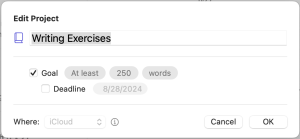
The first exercises I did was a free write for fifteen minutes. It was 600+ words long, which was much too long for most of the exercises. 250 words seems like a good setting for now.

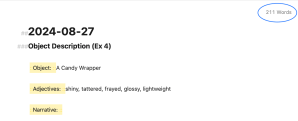
I can now cut and paste the needed parts of the template for any given exercise into the sheet for that day and start typing. A nice feature of Ulysses is how it shows statistics on the sheet you’re working on. For this exercise, I can easily see its 211 words, including titles and the template prompts:
You can also see statistics for a group or project overall simply by selecting them and looking:
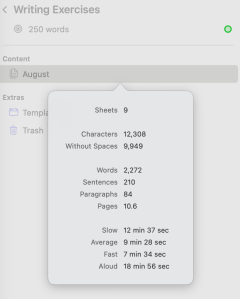
If you’ve met your goal on the project, you see the green circle at the top level acknowledging the goal for the day.

What could be better:

I’m still learning all of the capabilities of Ulysses, but here are few immediate opportunities for improvement:

  • Timed goal. It would be nice to set a goal based on time rather than words or characters. I believe I’ve reached a nice compromise for my exercises, but feel a timed goal for free writing or other project types may work better.
  • Templates. The templates folder is nice, but you can’t (or I don’t know how) to make true templates. I’d like the ability to create a sheet in a project group from a template, similar to how you can create a document in MS Word from a template. I understand the MS Word use-case is more about formatting and styles, which Ulysses tries to de-couple from your writing, but I’d appreciate that sort of feature. Until then, copy and past works.
  • Links. I’d like the ability to link to a sheet within the application. It would be nice to link my plan to the sheet that carries the exercise for the day. Conversely, I’ve moved one of my works in progress into the tool and would like to link and cross reference some character notes to them in the narrative. Since Ulysses does decouple style and output from the text in the sheet, making a non-exporting link should be easy.

Ulysses has a lot of other features and use-cases beyond my writing exercises. I’m still in the early-days of adopting it, but I am enjoying it so far. I have one major writing project I’ve migrated into it. It has helped me add over 20k words to that novel since importing it less than ten days ago. Many other writers have shared how they use the tool. I’ll continue exploring its usage and limits and let you know as I learn and grow.


If you are using Ulysses and have any tips or tricks I should try, drop a comment here. Otherwise, good luck, and have fun writing.


Follow me on AmazonGoodReads, or Facebook to get information about upcoming book releases.

Discussing Excerpt Five | Marketing Mondays

One of the problems with writing Erotic Science Fiction is the fact that many potential readers assume the focus is on the erotic elements rather than the underlying science fiction and general plot. To try and overcome this perception, I’ve started posting excerpts from my books that highlight some of non-erotic elements to show characters and conflicts that hopefully appeal to the more mainstream readers. These excerpts will be shared on Mondays and I’ve created a tag “MarketingMondays” to track the postings.

As the excerpts run, I’ll watch sales numbers and see if they are helping.


My fifth posted excerpt was for subscribers only since it covered one of the explicit scenes from Cosimo, a Families of the Empire Story . I debated whether to include a spicy scene in my MarketingMonday’s effort, since I realize it could be off-putting to some readers. Also, by making it available only to subscribers, it’s unlikely to have sufficient reach to improve sales.

So, why did I do it?

A couple of reasons. The excerpt is the opening scene from chapter seven of the book. This chapter was first published online as a stand-alone short story entitled “Seventh Day”. It won the Short Erotic Story of the Year 2023 in a reader based competition. I was surprised the story was nominated for the Clitorides competition, let alone that it won its category.

I also think that a lot of the erotic science fiction being published recently is focused much more on the female point of view. That may be due to the target audience those authors are trying to reach or it could be something else, but this scene and book is written from Cosimo’s point of view. As such, it tries to portray a man’s view of the sexual acts described. Your own reactions to Cosimo’s feelings and thoughts may differ.

Finally, this chapter is pivotal for the characters’ development as it addresses Lexi’s family’s involuntary indenture and her father’s arrest for treason, a crime punishable by death in their culture. It also explores Cosimo’s perspective on his family’s role in the empire and their responsibilities in dealing with crime.

I’ll forgo my standard FAQ format for this discussion, since the obvious questions are answered in the prior chapter of the book, or within the remainder of this chapter. I encourage you to read the story and judge for yourselves. Cosimo is available on Amazon, as well as Smashwords and other ebook channels.


Follow me on AmazonGoodReads, or Facebook to get information about upcoming book releases.

Writing Exercises: Making a Plan

This is part of my writing exercises workbook, available to subscribers.


Part of exercising is creating a schedule and sticking to it.  Writing exercises are the same way.  The exercises I’ve outlined are intended to spark your creativity and help develop the habit of writing on a regular basis, even if the writing becomes throwaway work.  You need to exercise that creative muscle.  To help with this, here is a sample plan you can use as a starting point:

Day of Week (or date)Exercise / GoalAchievement
MondayCharacter Sketch (Exercise 1) 
TuesdayLocation Sketch (Exercise 3) 
WednesdayFree write (15 minutes) 
ThursdayCharacter Sketch (Exercise 2) 
FridayLocation Sketch (Exercise 4) 
SaturdayRest Day (do something fun!) 
SundayFree write (15 minutes) 
MondayCharacter Sketch (Exercise 2) 
TuesdayConflict Sketch (Exercise 5) 
WednesdayFree write (15 minutes) 
ThursdayPlot Outline (Exercise 6) 
FridayShort story (Exercise 7) 
SaturdayShort story (Exercise 7) 
SundayRest Day (do something fun!) 
   

The workbook available for free to subscribers includes this as a blank template you can tailor to your own needs. If you have other exercises you enjoy, include them (and share them in the comments). Maybe you like to write a haiku on a regular basis. Add it as an exercise to your schedule.

If you can’t commit to and exercise every day, then don’t. You can use the Achievement column to track your actual exercise progress. If you run out of lines, add more, or celebrate completing you plan and then start a new one. Remember, practice leads to the habit of writing, which is what all of these exercises are about.

Good luck, and have fun writing.


Follow me on AmazonGoodReads, or Facebook to get information about upcoming book releases.

Discussing Excerpt Four | Marketing Mondays

One of the problems with writing Erotic Science Fiction is the fact that many potential readers assume the focus is on the erotic elements rather than the underlying science fiction and general plot. To try and overcome this perception, I’ve started posting excerpts from my books that highlight some of non-erotic elements to show characters and conflicts that hopefully appeal to the more mainstream readers. These excerpts will be shared on Mondays and I’ve created a tag “MarketingMondays” to track the postings.

As the excerpts run, I’ll watch sales numbers and see if they are helping.


My fourth excerpt is from Cosimo, a Families of the Empire Story The scene I selected is the second chapter of the book and sets the stage for much of the culture that is explored in the remainder of the tale. I chose this scene since it is the first look into the new world the colonists are establishing. While it skips past a lot of detail on the turmoil and challenge facing the colonists, it provides a brief glimpse at two hidden families who are pledged to work away from the limelight to preserve and protect the fledgling empire they have birthed.

For anyone who has not yet read the books, there are likely a few obvious questions I can answer. If you have additional question I can answer, please leave a comment on this or the excerpt posting.

  • What was in the syringe Ayako used? It’s implied to be the compound Ayako developed and used on the colonists in the prior chapter to ensure the mental conditioning remains in place to follow the original colonist leadership’s plan.
  • Why would the first emperor need the conditioning? This whole chapter will possibly be expanded into another book in the future. For the scene, I wanted to show that the two hidden families who watch and judge from the shadows are a little ruthless in exercising their powers. Since Ayako and Kira discuss what will become of the Emperor’s daughter and son-in-law who tried to usurp power, they want to ensure Talia follows through on the plan they have in place.
  • What’s the club Ayako is considering? Ayako is Cosimo’s distant ancestor. She creates the Amorperdita Club which permeates the future empire as a place to see and be seen. The club organization is run by Cosimo’s family and forms the network of eyes and ears they use to keep tabs on the aristocratic and high guilder families that may attempt to subvert the empire.
  • When does the real story start? The book has a prologue and three chapters that set the stage for the main story. All told, the first 7,000 words of the book are stage-setting to get the reader enough context to understand the world Cosimo emerges into and the tale that follows. The book covers approximately 200,000 words, so the stage-setting accounts for about 4% of the overall tale.

Follow me on Amazon, GoodReads, or Facebook to get information about upcoming book releases.
Character-Driven Erotic Science Fiction: Cosimo, a Families of the Empire Story

One of the problems with writing Erotic Science Fiction is the fact that many potential readers assume the focus is on the erotic elements rather than the underlying science fiction and general plot. To try and overcome this perception, I’m sharing some excerpts from my stories to share some of the “non-erotic” elements.


Cosimo, a Families of the Empire Story is my most problematic title. While it has explicit content, it also has what I feel is a strongly character-driven plot. The character of the story lives within a culture in the far future. Part of the culture includes voluntary and involuntary indenture. Couple this with some of the explicit scenes and situations, and the story falls into what some consider troublesome topics such as slavery and trafficking. However, this is the problem with labeling works in the worst-possible light. I did not set out to write anything endorsing current-day beliefs or problems. Anyway, here is a non-explicit excerpt for your enjoyment. This is chapter two of the book.

“She’s coming around,” Kira said as she looked down at Talia Dennison, first Emperor of the new empire.  

“Talia, do you hear me?” Ayako asked softly, leaning toward her long-time friend’s ear. 

“Uhmmm,” Talia mumbled.

“Can you move your right hand?” Kira asked.  

The patient’s hand twitched.

“Good.  Now your left.”

Her left fingers fluttered. 

“Excellent.  You’re past the worst of it,” Kira said.  “Now it’s just going to take time for your body to shake off the affects and for you to get some strength back.”

Ayako sat back and then glanced at the tube feeding nutrients and medicines into the emperor.  She held up a small syringe and looked at Kira, the former chief medical officer of “Man’s Hope” while keeping it out of Talia’s sight. 

Kira nodded.

Ayako slipped the needle into the socket on the tube and slowly pushed in the plunger.  Kira leaned close to Talia’s ear and whispered.  Ayako handed Kira a plastic and metal band which the doctor slipped onto Talia’s head.  Two pads rested on the patient’s temples, and she pushed an activation switch.  Talia’s eyes fluttered and then closed.

Kira and Ayako sat back and exchanged a look.

“We were lucky,” Kira said.  “If I hadn’t gotten my team here as quickly as I did, we would not have been able to revive her.  I can’t imagine what would have happened if Darius had succeeded.  We would have a short-lived empire then.”

Ayako nodded.  “We would have dealt with him, but the trust built with the people since landing would have been broken.”

Kira rubbed her temples and sighed.  “How will Talia react when she learns that her loving son-in-law tried to overthrow the emperor?  How will her daughter react?”

“Her daughter will be spared but cannot be trusted with any power.  I’ll take her away with me.  Her grandson will come to the capital to be with his grandmother.  He will inherit the mantel of the Dennison line when Talia does finally pass.  Hopefully she’ll have enough time to get him trained.”

“Barring an accident or another attempt on her life, she should be good for twenty or so more years.  Of course, once she recovers and understands the depth of her family’s betrayal, she may step down.”

“No, we can’t allow that,” Ayako said.  “Maybe in a decade, but not in the short-term.  Our culture is starting to solidify with the academies and collegium.  People are generally happy.  The other colonies are faltering, as we expected.  We have to remain strong, or the world will devolve, and our race will be at risk.”

“What will you do to Laura?” Kira asked, curious how Talia’s daughter would be treated.

“My son needs a suitable mate.  She will be tamed and used to benefit the empire,” Ayako said.  

Kira looked up sharply.  “Your research?”

Ayako nodded.  “Laura Dennison will be my final test subject.  Her husband’s life is forfeit.  I’ll not waste resources on him.  For our friend’s sake, her daughter will be indentured and bound to my son.  My family will continue through the bloodline of my friend’s daughter, but she will have no power to threaten us ever again.”

Kira nodded.  “I’ll take genetic samples from Darius.  We don’t want to lose any bloodlines.”

“Take them yourself, today, Kira.  Tomorrow, Ksogi will do his duty in closed session with the Senate as witness.  We will then reinforce their oaths to the empire.”

“It seems barbaric, but I understand.  I’ll bear witness as well.”

Ayako nodded; her lips set in a grim tight line.  “Barbaric, yes, but required.  We need to remember so many of our shipmates who have slipped into barbarism.  Might makes right in their world now.  We must be better, to strive and stabilize our culture and world,” she said passionately.

“Our civic institutions will survive, since we stopped this plot,” Kira said.  

“But the plot was born because we do not yet have firm social structures and norms,” Ayako said.  “We need accepted social interactions that will prevent the aristocracy from only interacting amongst themselves.  If we did not hear from Conner about Talia’s health, we would not have been in position to act.  A simple conversation based on a random observation tipped their hand.  It was happenstance and luck.  We need to create social structures that will tip the odds of that sort of luck in our favor.”

“What are you thinking?  It’s hard for my people to monitor the empire from orbit with the communications restrictions we’ve adopted.  How will you manage random conversations across millions of people?”

“I may have an idea,” she said.  Ayako considered their world.  Perhaps she had an idea.  She wished Kgosi was still alive to provide his counsel.  Maybe it was just a dream.  She would not know if she did not try.

“I think I’ll open a very special club here, and in my hometown.  We will cater to the rich, ambitious, and powerful.  I will create the social scene needed for us to watch from the wings and be prepared.  Can I count on your support?”

“Always, my old friend.  Now tell me more about this idea and the vision for your club.”

“Less of a vision than an idea at the moment.  It will be exclusive.  It will be private.  It will be both where people want to be seen and where people know they can meet for a private rendezvous.  It will be discreet.  It will cater to people’s senses and desires.”

“And be filled with your eyes and ears?” Kira asked.

Ayako nodded. 


This chapter is the shortest in the book, and sets the scene for much of the culture examined in the remainder of the book. For subscribers here, I’ll also be posting a short excerpt of a more explicit scene next week, so you can draw your own conclusions on what the story entails. Cosimo is available on Amazon, as well as Smashwords and other ebook channels.


Follow me on AmazonGoodReads, or Facebook to get information about upcoming book releases.

Writing Exercise 7: Draft a Short Story

This is part of my writing exercises workbook, available to subscribers.


This is a longer exercise, depending on your writing style.  However, it is not intended that you try to write a full, polished, ready to publish tale in a single setting.  It’s about getting your creative juices flowing and bringing in several of the other exercises for a complete narrative.

Begin with “It was a dark and stormy night…” or one of the other opening lines provided below and write a short story.  Focus on creating a vivid character or two, interesting locations with details that will engage the reader, and a strong sense of plot and conflict to move the story along.  

Opening Lines
1. Once upon a time…
2. It was a dark and stormy night…
3. In a galaxy far, far away…
4. Long ago in a land called…
5. It was a hot summer day…
6. On the edge of town…
7. As she stepped off the bus…
8. Once upon a starry night…
9. Far beyond the reaches of space and time…
10. In the heart of the city…
11. Deep within the woods…
12. At the stroke of midnight…
13. In the quiet stillness of the morning…
14. Beneath the shadows of an ancient oak tree…
15. High above the clouds…
16. On the eve of war…
17. Amidst the bustle of a busy marketplace…
18. At the beginning of winter…
19. Underneath the glow of a full moon…
20. As dawn broke over the horizon…

Since this is a longer exercise, give yourself time to complete it. Once complete, review your narrative relative to the other exercises. Is your conflict clear for the reader? Are there interesting and compelling character traits described? Are those traits relevant to the story? Do important objects or settings come to life in the tale? Can you clearly identify the climax of the plot? If you aren’t certain of the answers to these questions, your reader won’t be either, so it may be worth revisiting the exercises and performing them again.


Feel free to post on your own blog and link back here so other readers can learn from your own experience.

Good luck, and have fun writing.


Follow me on AmazonGoodReads, or Facebook to get information about upcoming book releases.

Discussing Excerpt Three | Marketing Mondays

One of the problems with writing Erotic Science Fiction is the fact that many potential readers assume the focus is on the erotic elements rather than the underlying science fiction and general plot. To try and overcome this perception, I’ve started posting excerpts from my books that highlight some of non-erotic elements to show characters and conflicts that hopefully appeal to the more mainstream readers. These excerpts will be shared on Mondays and I’ve created a tag “MarketingMondays” to track the postings.

As the excerpts run, I’ll watch sales numbers and see if they are helping.


Excerpt three is from Book Three, chapter two. Book Three opens with an action scene that sets the stage for the major conflicts Paul faces in the climax of the series. While that action segment sets the stage for much of the book, it also has details that may be jarring if a reader has not read the earlier books. For this reason, I chose this scene as being more relatable to the general reading audience.

It covers a promotional interview Joan Lunden is conducting to advertise Paul & Jeryl’s reality television series. By this point of the book, readers know that Paul is going to space and they have been introduced to the television series from the second book as well as the opening chapter of this one.

The scene helps paint Paul’s efforts and accomplishments in the broader world of the time. By this point in the overall series, he has succeeded in changing the world with his inventions as well as his educational efforts to encourage people to do their own thinking. Book three does very little “looking back” for the reader. It assumes they have followed along and read the first and second book already. This may be a poor precedent, but it was a choice I made while writing.

For anyone who has not yet read the books, there are likely a few obvious questions I can answer. If you have additional question I can answer, please leave a comment on this or the excerpt posting.

  • What is the television show Paul and Jeryl created? In Book Two, they launch a reality television show years before the concept became mainstream in the entertainment world. It started as “The Interns” focused on a blend of business problem solving, marketing, engineering, and general management. The intent (for Paul and Jeryl) was to encourage young entrepreneurs to try things, fail, learn, and try again. Book Two covers several seasons of the show, and Book Three launches it in new directions.
  • How realistic is the scene in zero-g? As realist as I could make it based on research of current astronaut training and experiences. If I portrayed any details inaccurately, I’ll simply plead lack of hands on experience on the author’s part.
  • Why did you use real people’s names as characters? This was a tough decisions when originally writing. When you’re telling any sort of story based on an alternative history or timeline, you want to anchor readers in a world they are potentially familiar with. Using well-known public figures is one technique I chose to create a sense of time and place. I did add a disclaimer at the beginning of each book:

Disclaimer: This is a work of fiction.  The story depicts an alternative, invented “reality” or timeline.  All incidents and dialogue, and all characters with the exception of some well-known historical figures, are products of the author’s imagination and are not to be construed as real. Where real-life historical figures appear, the situations, incidents, and dialogues concerning those persons are entirely fictional and are not intended to depict actual events or to change the entirely fictional nature of the work.  Some of the characters in the story are based on actual people, but none of the events depicted in the story are actual events.  In all other respects, any resemblance to actual persons, living or dead, events, or locales is entirely coincidental.

  • What else happens in Book Three? [No spoilers here]. Book three is the climax to the series. If catapults Paul to the center of geopolitical conflict and forces him to face his own mortality, his own morality, and loss he cannot overcome with his knowledge of a future world. It brings the saga to a conclusion while leaving the door open for more stories if the muse ever strikes me to revisit the world.
  • Will there be a Book Four? No. Paul’s tale is concluded in my mind. While there are possible stories in the universe that has been created, I don’t want to continue following along in Paul’s wake.
  • Why not? As a reader, I dislike stories that never end. I don’t want to be an author that makes my readers wait for “yet one more extension” of a tale. Book three concludes the story I set out to tell. It creates what I think is a unique “do-over” tale that avoids tropes of getting rich by knowing what the financial market does. It also explores the impact a person with advance knowledge may have even in the modern world. Many writers in the genre send their protagonist in the distant past in the vein of “A Connecticut Yankee in King Arthur’s Court”, but few tackle such a story in the near past. That is the challenge I took on, and I think I did it well, so I’ve chosen to stop here.

Tell me what you think….

Please like the Marketing Monday posts if you find these behind-the-scenes discussions useful. It there are questions that come to mind from the excerpts or these follow-up posts, leave a comment and let me know. I’m also open to any questions on GoodReads, if you prefer that platform.


Follow me on Amazon, GoodReads, or Facebook to get information about upcoming book releases.

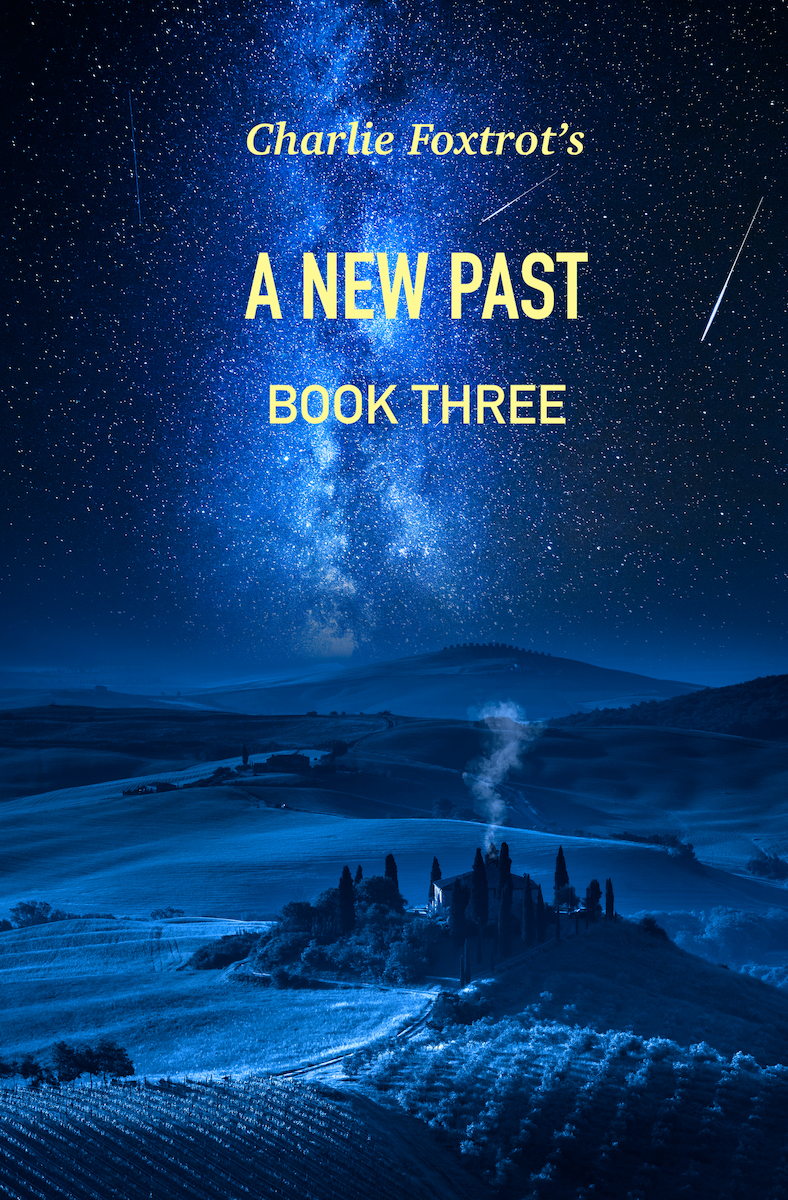
Unlocking Geopolitical Intrigue in A New Past: Book Three


One of the problems with writing Erotic Science Fiction is the fact that many potential readers assume the focus is on the erotic elements rather than the underlying science fiction and general plot. To try and overcome this perception, I’m sharing some excerpts from my series, A New Past to share some of the “non-erotic” elements. This excerpt is from Book Three, Chapter 2 and shows some of the interaction Paul has with the television world as he and Jeryl continue to define and expand the genre of “reality television” with a scientific bent.


“So, Paul, anything you can share about this year’s season of ‘The Interns’?” Joan Lunden asked.

“That would be telling tales out of school,” I replied with a smile. 

We were filming a segment for Good Morning America.  The network had asked that we do a more in-depth piece that they could include in a live broadcast closer to the season premier.  Once we figured out the schedules, Joan had flown out to California to tape the segment.

She smiled for the camera and then looked back at me.  “One of the things that appeals to almost every fan of the show, is the mix of physical and mental challenges you present. What types of hurdles will interns face this year?”

“As we say on the show quite a bit, I think it’s better to show, than tell.  How would you like to face one of the challenges they will experience?” 

Her laugh sounded natural and un-forced.  “I’m usually up for a challenge.”

“Well then let’s get you suited up.”

“Cut!” the director called.  We had roughly scripted this introduction.  

“We’ve got all the gear you’ll need,” Tamara said as she stepped closer.  She was helping cover this challenge as part of our own run through to make sure everything was set. 

“What torture are you planning for me?” Joan asked as she stood and began following Tamara to her dressing room.

“No torture.  We’ll be having the interns do some zero-g work for part of one of their challenges.  We thought it might make a good segment for your show, if we showed you in the same environment.  We don’t want to spoil the challenge but showing you floating and working with Paul to get used to the environment should be a nice teaser for the audience.”

Joan looked a little skeptical.

“Don’t worry, I did the full training a few weeks ago.  Once your inner ear adjusts, it’s kind of fun.”

Three hours later, Joan let out a little shriek as she floated away from the wall and found herself unable to get ahold of anything to move under her own control.

“Simulation, my ass!” she said with a laugh.

I reached out for her hand and pulled her back to the small platform we were supposed to stay next too.

“So, as you can see, the interns are going to have to develop some new thought patterns as they work in this type of environment.  They will get a couple of days in zero-g for one challenge and have to learn to not just live but work up here.”

I had arranged for a quick hop to Edwards followed by a launch of an orbiter just for the show.  The cargo bay had been fitted with a large, pressurized habitat that contained the padded training space they would occupy.  Their challenge would be to help improve and finalize the layout of facilities in a zero-g environment, but we did not want to spoil that challenge today.

“I bet they learn to not stray from the handholds pretty quickly,” Joan said before deliberately pushing off to sail across to the opposite bulkhead.

I followed her across, nodding.

“I think that is a lesson they will learn quickly.”

We finished filming with a couple of mid-air flips before the pilot announced we needed to return to our seats for the start of our de-orbit maneuvers.

“I can’t believe you kidnapped me and shot me into space,” Joan joked once we were back on terra firma.

“It can’t be kidnapping when your producer sends you on the job,” I replied. 

“I suppose not.  I think you just made me the first journalist in orbit.  Thank you.”

I smiled.  “You are welcome.  I guess I’ll see you in New York in a few weeks.”  

We shook hands and parted ways. 


Book Three is the epic conclusion of Paul’s tale and sees him lock-horns with geopolitical adversaries as he works to make a better world. A New Past is available on Amazon, as well as Smashwords and other ebook channels.


Follow me on AmazonGoodReads, or Facebook to get information about upcoming book releases.

Writing Exercise 6: Plot Outlines

This is part of my writing exercises workbook, available to subscribers.


Outlining a story involves breaking down its main components into manageable parts. First, start with an introduction or hook that captures readers’ attention and sets the stage for what is to come. Then move onto the rising action section where tension builds up gradually towards a climax. After this comes the climax itself – usually the most intense part of the story where everything comes to a head. Following this should be a resolution or denouement, which resolves any remaining conflicts and provides closure for characters and readers alike. Finally, don’t forget about your conclusion or ending which leaves readers with something memorable or thought-provoking.


For this exercise, we’ll us a simplified plot outline and write a brief narrative for each section.  Let’s look at a simple example first:

Introduction/Hook:

Draft a narrative to open the story and set the stage for the tale.  The details here may change over time, but establishing a strong sense of place and character in a brief narrative will help with the overall outline of your story and set the stage for the conflicts your character will face and overcome.

In the bustling heart of the steam-punk metropolis, Izzy stood alone amidst the cacophony of whistles and gears. Her worn leather boots were stained with grease from countless hours spent tinkering in the master artificer’s workshop, yet she had been dismissed without warning due to a series of unfortunate accidents. As Izzy gazed up at the imposing clock tower that loomed over her humble home, determination flickered within her eyes. This was not an end but merely a beginning; for though the master artificer might have cast her out, she would prove herself worthy in this unforgiving city.

Plot Conflicts; what are the challenges Izzy will face in the story?  

Depending on your planned story length, you may want to pick multiple conflicts to move the plot along. You should decide what the major point of conflict for the overall tale is, even if there will be other conflicts within the story.

  • Proving herself capable: Izzy must demonstrate her skills and knowledge as an artificer, overcoming any doubts or biases from others who see her as merely a “troublemaker.”
  • Finding a mentor: Without access to the master artificer’s workshop, Izzy will need to find another experienced artisan willing to take her under their wing and help guide her towards earning her own license.  
  • Conflict with the master artificer: Izzy may struggle to prove herself worthy despite being dismissed from the workshop due to accidents. This conflict could lead to tension between them and their former mentor, potentially forcing Izzy to find alternative means of acquiring the skills and knowledge needed to succeed as an artificer.
  • Conflict with other aspiring artisans: As Izzy seeks out new mentors or works to establish themselves in the industry, they may encounter jealousy, rivalry, or sabotage from competing artificers who view them as a threat to their own success.
  • Securing financial support: To open her own shop or workspace, Izzy may require start-up capital which can be difficult for someone starting out in this competitive field.
  • External conflicts: Izzy could face challenges such as limited resources, dangerous working conditions, or political machinations within the guild that threaten their ability to achieve their goals.

These challenges can easily be tailored to different genres as well:

  • Fantasy: In this genre, Izzy’s story could focus on her quest to find rare materials or lost knowledge needed to create powerful artifacts that could help save her world from an impending threat.
  • Steampunk Romance: The love interest of another artificer could be introduced, leading to a story about their growing relationship while also exploring the challenges they face working together in such a competitive field.
  • Cyberpunk Thriller: With cyborg elements added, Izzy’s story could revolve around her pursuit of justice against corrupt forces within the artificer guild who are using their technology for nefarious purposes.

Climax

This is where and how the major plot conflict is resolved.  Picking you climax before you start writing gives you a solid milestone to write toward.   Once again, draft a narrative describing this climactic scene.

As she stood before the panel of judges, Izzy’s heart pounded with anticipation. The years of hard work and perseverance had led up to this moment – a chance to prove herself as an artist in her own right. With steady hands, she activated the device she had spent countless hours perfecting. It hummed softly beneath her touch, its intricate mechanisms coming alive with graceful precision. The judges watched in silence, their eyes reflecting admiration and respect for the masterpiece before them. As they awarded Izzy her artificer’s license, she glanced towards the door where her former mentor stood watching from a distance. For the first time, he offered her a small nod of approval – a sign that perhaps, just maybe, he had finally come to terms with his own role in her journey.

Conclusion

Make certain you wrap up any loose ends in the tale or set the stage for the next adventure.  Try to focus on what feelings you want your character to express, and what you want your readers to take away from the story.

As she sat in her new workshop, surrounded by tools and parts that had once been denied her, Izzy felt an overwhelming sense of accomplishment. Her artificer’s license now hung proudly on the wall above her workbench – a tangible symbol of her hard-won success. With renewed determination, she turned back to the task at hand: crafting something truly unique and magnificent. The hours melted away as she lost herself in her work, unaware of anything but the intricate dance of gears and cogs beneath her fingers. And though challenges would undoubtedly arise in the future, for now Izzy reveled in this moment: the sweet taste of victory after years spent struggling against adversity.

The key to this exercise is to remain focused on the parts of the plot and not get mired down in expanding the details. Focus on creating the three narratives outlined here: the introduction or hook, the climax (after thinking about the conflicts to be faced), and the conclusion. If you come up with a storyline you want to expand and explore, great! Don’t do that expansion and exploration during the exercise. The writing exercises outlined in this series are intended to help you develop the habit of writing and thinking about various elements in story-telling.

Good luck, and have fun writing.


Follow me on AmazonGoodReads, or Facebook to get information about upcoming book releases.