
Writing Exercise 1: Character Development

As writers, we often find ourselves staring at blank pages or screens, searching for inspiration to bring our characters to life. One effective way to spark creativity and develop unique characters is through creative writing exercises. In this post, I’ll guide you through a simple character sketching activity that can help unlock your imagination and get those creative juices flowing! This (and other) exercises are compliments to my series of posts on creating compelling characters. These are exercises to help us get in the habit of writing.


For the first part of this exercise, we’ll use a list of random adjectives and nouns to inspire our characters’ personalities and traits. You may want to print out these lists or keep them open on your computer screen for easy access:

AdjectivesNouns
1. Brave
2. Cunning
3. Determined
4. Enigmatic
5. Fierce
6. Generous
7. Hesitant
8. Intelligent
9. Jealous
10. Kind
11. Lazy
12. Nervous
13. Observant
14. Pessimistic
15. Quiet
16. Rebellious
17. Sarcastic
18. Sneaky
19. Thoughtful
20. Unpredictable
1. Backpack
2. Butterfly net
3. Compass
4. Flashlight
5. Hat
6. Ice cream truck
7. Jigsaw puzzle
8. Kaleidoscope
9. Lighter
10. Monocle
11. Notebook
12. Ocarina
13. Paintbrushes
14. Quill pen
15. Razor blade
16. Sewing kit
17. Telescope
18. Umbrella
19. Vase
20. Wheelchair

Now, pick one adjective and one noun from each list at random. For example, if you draw “cunning” and “compass,” your character might be a clever navigator who uses her skills to outsmart others in tricky situations. Mix and match as many combinations as you like!

Once you’ve selected your pairings, create a short description of the character based on their chosen traits and possessions. Be sure to include details that convey their personality, appearance, and background. For instance:

Cunning navigator Althea carried her trusty compass everywhere she went. With her sharp mind and keen observational skills, she could find her way through the densest forests or most confusing city streets. Her deep-set eyes showed wisdom beyond her years, and her long braid held secrets of past adventures.

This example is nearly throw-away work, but it gets your creative juices flowing and helps reinforce the habit of writing.


This simple exercise can spark countless ideas for stories, novels, or even individual characters within a larger narrative. So don’t be afraid to mix and match until you find a combination that truly resonates with you – after all, inspiration often strikes when we least expect it!

Note: All of the exercises in this series will be available on my writing exercises page.


Follow me on AmazonGoodReads, or Facebook to get information about upcoming book releases.

Writing Exercises for Inspiration: Unlocking Creativity

As writers, we often find ourselves at a loss for inspiration. The blank page stares back at us, taunting our creativity. However, there are ways to spark new ideas and breathe life into our stories. Writing prompts and exercises can provide the necessary tools to unlock your imagination and take your writing to the next level.

Firstly, character development exercises allow you to explore different personalities and perspectives. By using random adjectives and nouns to create a character sketch, or by focusing on specific traits in a character profile, you can uncover unique aspects of your characters that may have otherwise gone undiscovered. This not only enriches your story but also challenges you as a writer.

Next, setting and description exercises help to create vivid images in the reader’s mind. Whether it’s describing an unfamiliar place or bringing a mundane object to life, these prompts encourage you to utilize all five senses and paint a detailed picture for your readers. This level of engagement can make the difference between a good story and a truly memorable one.

Finally, plot and conflict exercises help structure your narrative and ensure that there is tension throughout. Starting with a classic opening line like “It was a dark and stormy night…” or outlining the main plot points of a novel using visual tools can aid in organizing thoughts and ensuring coherence within your story.

This series will present several exercises along these lines and then show how I approached them to spark your own creativity. Subscribe today so you don’t miss any of the posts.


Writing Exercises Series

This is the introductory post on a series of writing exercises. I plan on posting to this series once a week over the next few months. For subscribers to my ramblings, the entire series will be consolidated into a free downloadable workbook for your use in your own writing. The workbook will be posted after the second exercises is published.


Follow me on AmazonGoodReads, or Facebook to get information about upcoming book releases.

Engaging and Original Sci-Fi Do-Over Story | Book Review

Complete Review:

I have a Thing for do-over stories—where the protagonist finds themself returned to an earlier point in their life. A chance to do things over, hopefully better this time. The appeal may be a reflection of my middle-age, but I still roll with it. My point being, I’ve read a lot of them.

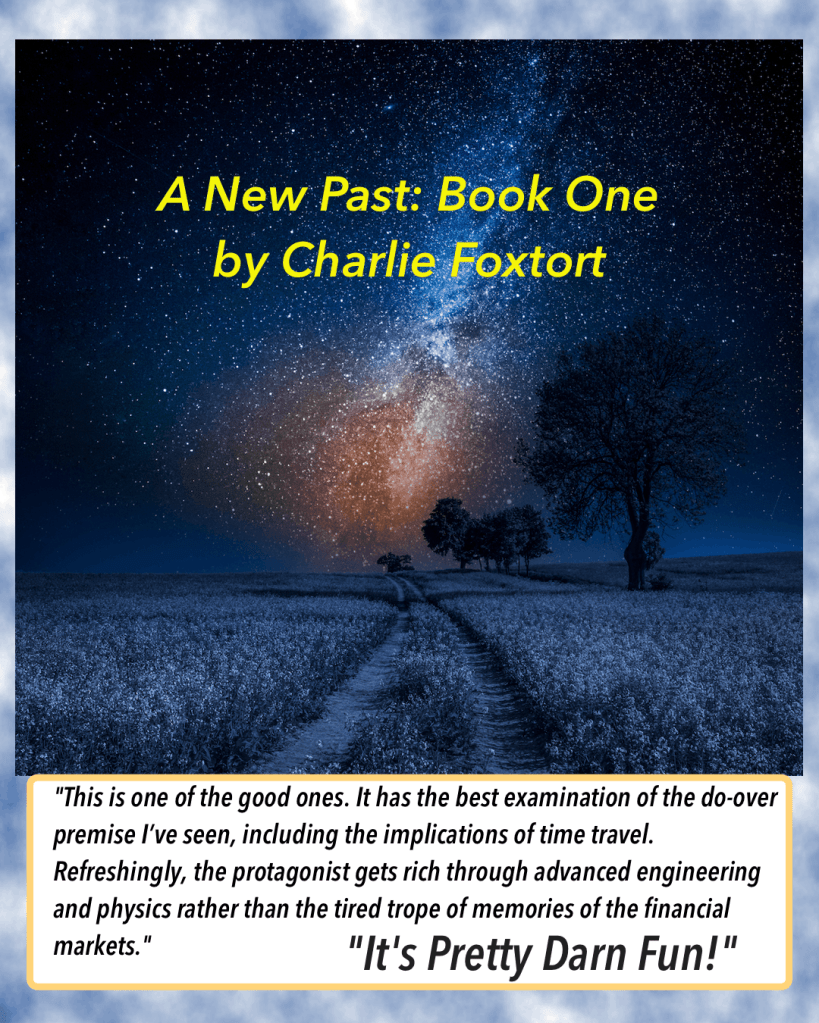
This is one of the good ones. In particular, it has the best examination of the science-fictional aspects of a do-over premise I’ve seen, including its implications of time travel. Refreshingly, the protagonist gets rich through advanced engineering and physics rather than the tired trope of memories of the financial markets. I like that. I also like that it’s pretty darn fun.

All of the above makes this a plot-driven story, but one that drives towards a character-based dilemma in a really effective way. Best of all, it NAILS the ending so, so well—way better than most such stories.

Highly recommended.


Follow me on AmazonGoodReads, or Facebook to get information about upcoming book releases.

The Power of Persistence: Stories of Writers Who Refused to Give Up

Have you ever felt like throwing in the towel after receiving yet another rejection letter, or seeing slow sales for those of us self-publishing? Believe it or not, some of the most successful writers in history faced rejection countless times before finally achieving their dreams. Let’s take a look at a few inspiring examples:

  • J.K. Rowling was rejected by twelve publishers before Harry Potter and the Philosopher’s Stone found a home with Bloomsbury.
  • Stephen King’s Carrie was initially rejected thirty times before being published. Today, it’s a classic horror novel.
  • Agatha Christie’s first novel, The Mysterious Affair at Styles, was rejected six times before finding a publisher.

These stories of persistence remind us that rejection is not a reflection of our worth as writers. Instead, it’s an opportunity to learn and grow. So the next time you face a setback, take heart in these examples and remember: every successful writer was once where you are now. Keep writing, keep refining your craft, and never give up on your dreams!


Follow me on AmazonGoodReads, or Facebook to get information about upcoming book releases.
Independence Day: Show Your Support for Independent Authors!

Are you tired of the same old bestsellers dominating bookstore shelves? Do you want to discover new, undiscovered gems that truly capture your imagination? Look no further than independent authors – they’re the unsung heroes of the literary world.

As an avid reader and supporter of indie authors myself, I’ve come across some incredible books that deserve more recognition than they receive. That’s why I’m asking you to join me in showcasing these talented writers on Amazon, Goodreads, or any other platform.

By submitting a favorable review for one (or more!) of your favorite indie authors, you can help boost their visibility and encourage others to give their works a chance. Your honest feedback will not only make the author’s day – it could also lead to increased sales, which means they’ll be able to continue doing what they love most: creating thought-provoking stories for us all to enjoy.

So please, take some time today to leave a positive review on Amazon. Let’s work together to shine a spotlight on these incredible authors and help them reach new heights in their careers. And who knows? Maybe you’ll discover your next favorite read along the way.


I happen to have a few titles I’d appreciate some positive reviews on from readers.

Positive ratings and reviews have a tremendous impact on sales, so if you’ve read my works and liked them, please take a minute to rate or share what you liked most. Thanks.


Follow me on AmazonGoodReads, or Facebook to get information about upcoming book releases.

Free Writing

I’ve been struggling to get back in my writing groove. Hence my las post about writers block. One technique that is often suggested when you’re feeling blocked is Free Writing. Here’s a little more on this helpful technique.


Free writing is an excellent technique for breaking through writer’s block and unleashing your creative potential. It involves writing whatever comes to mind without stopping or editing yourself. Here are some tips on how to approach this liberating form of expression:

1. Set a timer: Decide on a time limit, such as 10 minutes, and write non-stop during that period. The pressure of the clock can help keep you focused and avoid overthinking each sentence.

2. Don’t think too hard: Just let your thoughts flow freely onto the page. This is not the time for crafting perfect sentences or worrying about grammar. Your goal is to get those ideas out of your head and onto paper.

3. Write anything: There are no rules in free writing. You can write about your day, your feelings, an imaginary story, or even gibberish if that’s what feels right at the moment. The key is to let go of control and allow yourself to explore different avenues of expression.

4. Don’t stop: If you find yourself pausing mid-sentence, force yourself to continue writing until the timer goes off. Sometimes, the best ideas come when we least expect them.

5. Review later: Once your time is up, take a break before reading through what you’ve written. You might be surprised by how many interesting thoughts and ideas came out during your free writing session. Use this material as inspiration for future projects or simply as a way to clear your mind and refocus on your work.

Remember that free writing is an excellent tool for tapping into your creative wellspring. So don’t be afraid to let go of expectations and embrace the freedom of expressing yourself without judgment.

As I’ve been doing a little free writing to get back into my rhythm, I’ve chosen to use a text editor rather than a word processor. This helps me just write, and not worry about grammar, spelling or other errors. If you’re feeling blocked, give it a try.


Follow me on AmazonGoodReads, or Facebook to get information about upcoming book releases.
Unlocking the Keys to Overcoming Writer’s Block

Writer’s block can be a daunting obstacle, but it doesn’t have to derail your creativity. In this article, I’ll share some tried-and-true techniques that will help you break through those mental roadblocks and get your writing flowing again.

1. Take a break: Sometimes, the best way to overcome writer’s block is by stepping away from your work for a little while. Go for a walk, listen to music, or simply take some time off. This will give your mind a chance to rest and recharge, allowing new ideas and inspiration to surface when you return to writing.

2. Change your environment: If working in the same location is becoming stale, try changing up your surroundings. Find a different spot in your home or office where you feel more comfortable and creative. Alternatively, consider writing outside, at a coffee shop, or even on vacation – sometimes new scenery can spark fresh perspectives.

3. Use prompts and exercises: There are many excellent resources available online that provide writing prompts and exercises designed to kickstart creativity. These can range from simple word association games to more complex storytelling challenges. By engaging in these activities, you may find yourself breaking free from the confines of your usual writing style and discovering new approaches.

4. Read widely: Reading is one of the best ways to stimulate creativity and inspire original ideas. Expose yourself to different genres, time periods, and perspectives – you never know when a particular author’s technique or character development might spark an idea for your own work.

5. Practice freewriting: Freewriting involves writing continuously for a set amount of time, without stopping to edit or correct mistakes. This practice can help break down mental blocks by getting the creative juices flowing and allowing you to explore ideas freely. Set a timer for 10 minutes and see what comes out!

6. Collaborate with others: Sharing your work with fellow writers or seeking feedback from a trusted friend or mentor can be incredibly helpful in overcoming writer’s block. Hearing different perspectives on your writing may inspire new directions, while receiving constructive criticism can help identify areas that need improvement.

7. Embrace imperfection: Remember that first drafts are meant to be rough. Allow yourself the freedom to explore ideas without worrying about perfection – after all, revisions and edits will come later. By loosening up and letting go of self-criticism, you may find it easier to overcome writer’s block and get your thoughts down on paper.

8. Use technology: There are numerous writing apps and software programs designed to assist writers in overcoming various challenges, including writer’s block. These tools often include features like word count trackers, goal-setting functions, and distraction-free writing modes that can help you stay focused and productive.

Remember, every writer experiences moments of uncertainty or frustration at some point. By employing these strategies and remaining patient with yourself, you’ll soon find your creativity flowing once again!


Follow me on AmazonGoodReads, or Facebook to get information about upcoming book releases.

Revelations and Tensions: Unveiling Captain Dumont’s Sci-Fi Odyssey

Having spent a lot of words on character development and world building, I want to take a short pivot to share some of my own work in progress that I feel illustrate some of the concepts I’ve written about. These will be from works in progress, so may still need some editing and polishing before they ever get published. Comments and feedback are welcome.


I watched the man on the monitor, reading in his lavishly furnished apartment.  Part of me was resentful.  The view from his couch could have been a master’s painting with its fiery orange and pinks behind the spires of the city with just a hint of blue on the horizon from the ocean.  Millions would kill for the view alone, but we had showered more than money on the home of the man I watched.  His apartment had only the best.  Modern appliances in stainless steel; clean white cabinets floating above the dark grey granite countertops; a genuine leather couch and matching chairs.  The program had literally spared no expense in ensuring his comfort.  

Of course, many would say he deserved such creature comforts.  Some would argue.  Personally, I was caught in the middle, but it did not hurt myself or the project to provide such opulence to the program’s heroes.  The fact that giving them apartments we owned and controlled did give us certain advantages, including this vid feed allowing unobtrusive observation by a phalanx of psychologist and behavioral experts.  If our six heroes had an observable difference from the others in the program, we had to learn what it was.

I was almost ready to ask what I was looking for when the man on the monitor stood and threw the reading tablet from him to smash against the sleek fireplace next to the doors to his private balcony.  The violence of his action was shockingly unexpected.

“What was he reading?”  I asked as the recording froze.  His face was tight, as if he struggled to control some feeling.  

Dr. Pamela Carmichael shook her head.  “An ancient sci-fi title.  He had two paper copies of it before the trip.”

“Relevance?”  I asked.  

“No direct ties, that we are aware of.  It’s a tale loosely based on a plot similar to Rudyard Kipling’s tale ‘Kim’.”

I nodded.  My implant provided a synopsis, just enough to refresh my memory of the story of the orphan boy coming into his own as an agent in the great game of intrigue.  

“So why the scrutiny this morning?  I do have other tasks needing my attention,” I added with the slightest hint of impatience in my voice.

“You asked to be notified of any aberrations in any of the crew’s behavior.  Based on his profile, this is a significant break in discipline for Dumont.  His background and training are all about control.  He has thousands of flight hours as command pilot and it has been drilled into him to always be in control.  Lashing out at something in a book is very peculiar.”

Part of me agreed, but my specialty was not in psychology.   “He’s a man of action and adventure.  How long has he been cooped up in his apartment?”

“Six days,” another lab-coated doctor said.  “On the inaugural mission, they spent thirty days in isolation.”

“We also had sixteen survivors then, and we were actively debriefing them.  This trip, they are more like lab rats than crew.  I think I would be frustrated.”

“We’ve counted on some level of frustration.  That’s why each of the six has been provided relaxation and comfort for the post-mission period.”

I snorted.  “They’re more bored here than they were on the ship.  Have we asked him why he threw the tablet?  Do we know what he was reading specifically?  Do we know anything other than this recording shows us?”

“No, sir, but it is a break in behavior.”

“Doctor, I have close to six trillion new dollars being spent in this quarter re-starting jump-ship production.  I have the leaders of the world clamoring for progress reports.  I must decide if our six heroes are going to drop over dead for no reason or if the next jump won’t see fifty percent of the crew dead like the last one did.  I want to know if our survivors have a change or difference that might explain what in the hell happened on the mission.  I don’t care if they get a little frustrated and throw a reader tablet.”

“It might be a sign,” the Dr. started.

“A sign would be something significant.  I need something significant or some confirmation that we won’t have something significant happen.  Adrien Dumont learning to fly would be significant.  Adrien Dumont growing a new appendage would be significant.  Throwing a reader is not.”

Before the doctor could marshal another argument, I paused and raised my hand.

“This last mission only had them inside the ship, correct?”

She nodded.

“The ship that had the same atmosphere and life support systems they lived in before departing the system, right?”

Again, she nodded.

“So, there is no physiological reason they should be in isolation?” 

“No.  It was part of the mission protocol we developed.  We did not assume all six would survive and wanted to build time in the schedule to observe for differences.  Frankly, we wanted to see some divergence in physiological readings.  This ‘normal’ response means we’ve learned nothing with this mission.”

“Not true,” I countered.

“We’ve learned that six of the sixteen survivors of the first mission appear to be immune to whatever killed the others.  We should expect to see differences between them and those less fortunate travelers.”

“Besides being not dead?” the doctor asked.  “We’ve run thousands of samples and comparison panels.  We don’t even have a working hypothesis yet.  Hell, we don’t even have any real hints on what to look at.”

“Then we need to expand the sample sizes.”

“The risk….”

“The risk is something the program office will assess.  We have the volunteers.  We know early seeding with the jump ships is the best bet we have for long term species survivability.  We need to try again.”

It was a decision we had been driving toward for the better part of a year.  It was also a decision that I could only provide a recommendation on, but I felt I had seen enough.  If we did not proceed with the risk to handfuls of individuals, we ran a real risk for all mankind. 

“In the meantime, let’s end this charade.  I imagine Captain Dumont is frustrated at the imposed idleness.  Let’s get the man back to work.”


Setting things up

This is the opening scene in a planned novel. Without giving too much of the overall story away, it is a science fiction tale that will be heavily character driven with multiple layers of conflict before it is all said and done. This opening scene is intended to introduce the main character, Captain Dumont, without giving a full peek inside his mind and thoughts. At the same time, it should set up hints of the world the characters live in. Does it do its job? What do you want to learn more about after reading this first thousand words?

Comments are open.

There are no wrong answers.


Follow me on AmazonGoodReads, or Facebook to get information about upcoming book releases.

World Building (pt 10) – Another Example

Let’s perform the same exercise again, using a different scene to illustrate how world building can be inserted into an opening for a story to quickly establish a foundation for a new world.

Opening Scene : Trading Technology

The skyline of New York City shimmered with neon lights as the sun set, casting an otherworldly glow over the sprawling metropolis. The bustle of activity on the streets below was drowned out by the roar of engines overhead, signaling the arrival of another cargo ship from Mars.

Aboard the vessel, Captain Reese watched through the viewport as their craft docked at one of the city’s many spaceports. He had been making this trip between Earth and Mars for years now, ferrying goods back and forth between the two worlds that were slowly recovering from decades of war.

The cargo hold was filled with crates labeled with various technologies: energy generators, medical equipment, and even advanced computing systems. Each item represented months of hard work and risk for their small team of traders. As Captain Reese prepared to disembark, he couldn’t help but feel a sense of pride in what they had accomplished.

But not everyone shared his sentiment. His first officer, Alexandra, stood beside him, her eyes fixed on the towering buildings that rose above them. “We risk our lives for this?” she muttered under her breath. “For these outdated Earth technologies?”

Captain Reese glanced at her, an eyebrow raised in surprise. “These aren’t just any technologies, Alex,” he replied firmly. “They’re lifelines for people who still rely on them.”

Alexandra turned away, shaking her head. “We could be doing so much more with our resources,” she argued. “With Mars’ superior technology, we could revolutionize life on Earth.”

Their conversation was cut short by the sound of a nearby argument breaking out between two merchants negotiating over the contents of their shipment. It was a common occurrence in this trade hub, where wealthy Earth businessmen vied for the latest Martian innovations while offering a fraction of their true value.

As Captain Reese made his way through the crowded spaceport, he couldn’t help but feel conflicted. On one hand, he understood Alexandra’s frustration with the limitations placed on them by Earth’s archaic systems. But on the other hand, he knew that change didn’t come easily or quickly – especially not in a world still recovering from war.

For now, they would continue to trade technology, hoping that each item brought some small measure of progress towards unity between their two worlds.


The Breakdown

Culture and History: The story takes place in a futuristic setting where Earth and Mars have been involved in decades-long war. Now they are slowly recovering from it, relying on trade to rebuild their economies.

Laws, Ethics, and Morality: There is clear tension between traders who value the importance of Earth’s outdated technologies versus those who want to utilize Mars’ superior technology for advancement. This conflict highlights a moral dilemma surrounding progress versus preservation.

Technology and Infrastructure: The story revolves around trading cargo ships carrying various technological goods between Earth and Mars, showcasing the differences in infrastructure and technological development between the two worlds.

Political Structures and Economies: Both Earth and Mars have their own political structures, economies, and power dynamics at play which influence the nature of trade and cooperation between them. The story explores these complexities as well as individual characters’ perspectives on them.

Landscapes and Geology: The opening scene takes place in a bustling spaceport city skyline, with references to the neon lights and busy streets below reflecting an urban landscape.

Cosmology and Mythology: No direct mention of cosmology or mythology is made in this scene, but it could be implied through the use of terms like “archaic systems” and “superior technology,” suggesting a belief system where some technologies are considered more advanced than others.


I hope these two simplistic examples of how world building can inform your scene setting and even plot conflicts have been helpful. There are a lot of tools that can be used to help catalog and track the details of your world. I’ll share an overview of a few of these in my next post. I encourage you to try the simple exercises outlined in the last two posts to craft an opening scene that hints at the care you’ve placed in crafting your story’s world.


Follow me on AmazonGoodReads, or Facebook to get information about upcoming book releases.